

Produits
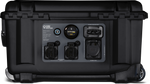 Pack de batteries énergétiques | 3kW
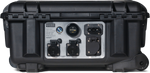 Bloc-batterie Pro | 5 kW
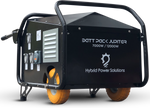 Batterie Jupiter | 7kW
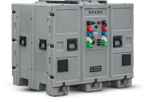 Spark Cube | 12kW/24kW
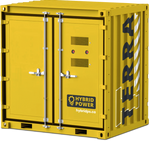 TERRA | 166kVA
Ressources

How to Integrate Solar Power Into Your Hybrid Generator
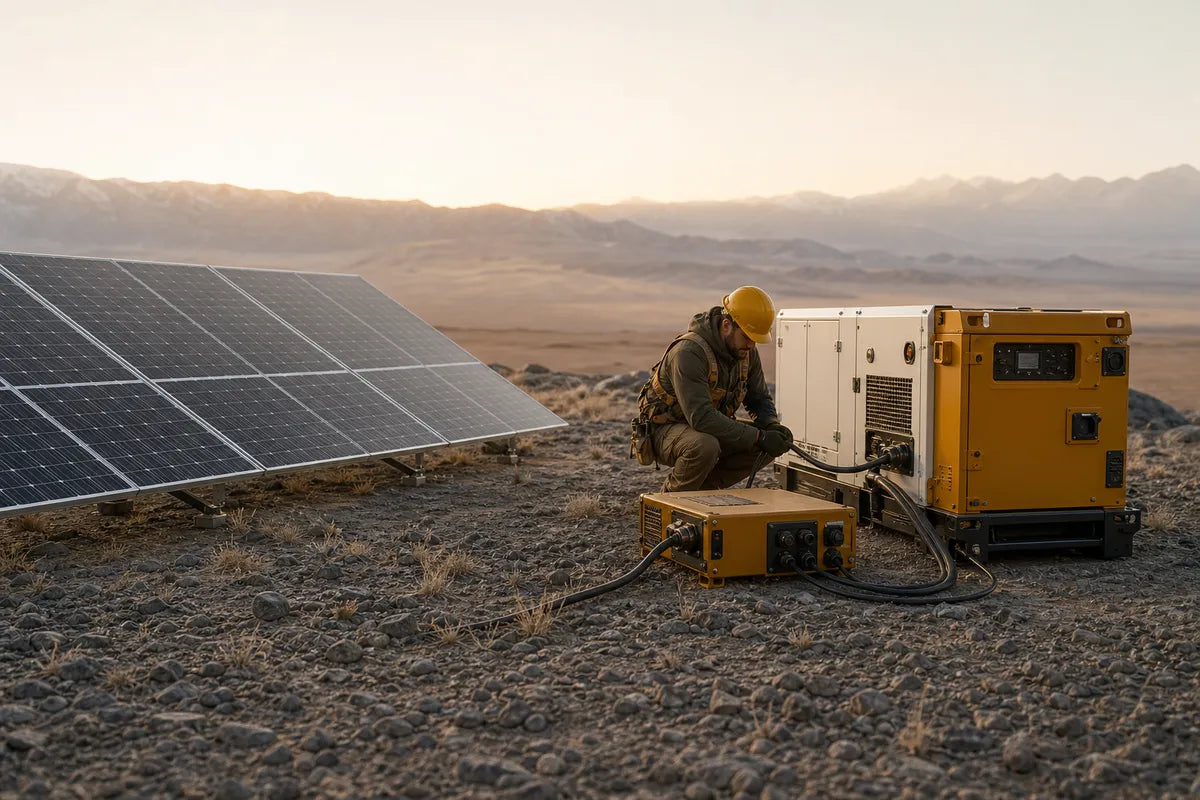
Learning how to integrate solar power into an industrial or field operation means connecting photovoltaic panels to a compatible inverter, battery storage, and existing power inputs, then configuring the system to manage load priority and charging automatically. For defence, construction, and rental applications, a hybrid multi-input architecture (solar plus alternator, grid, or generator) delivers the continuous runtime and cold-weather reliability that standalone solar cannot. Choosing the right system tier, from a portable battery pack to a high-capacity mobile microgrid, determines whether solar integration is a fuel-reduction tool or a full operational power strategy.
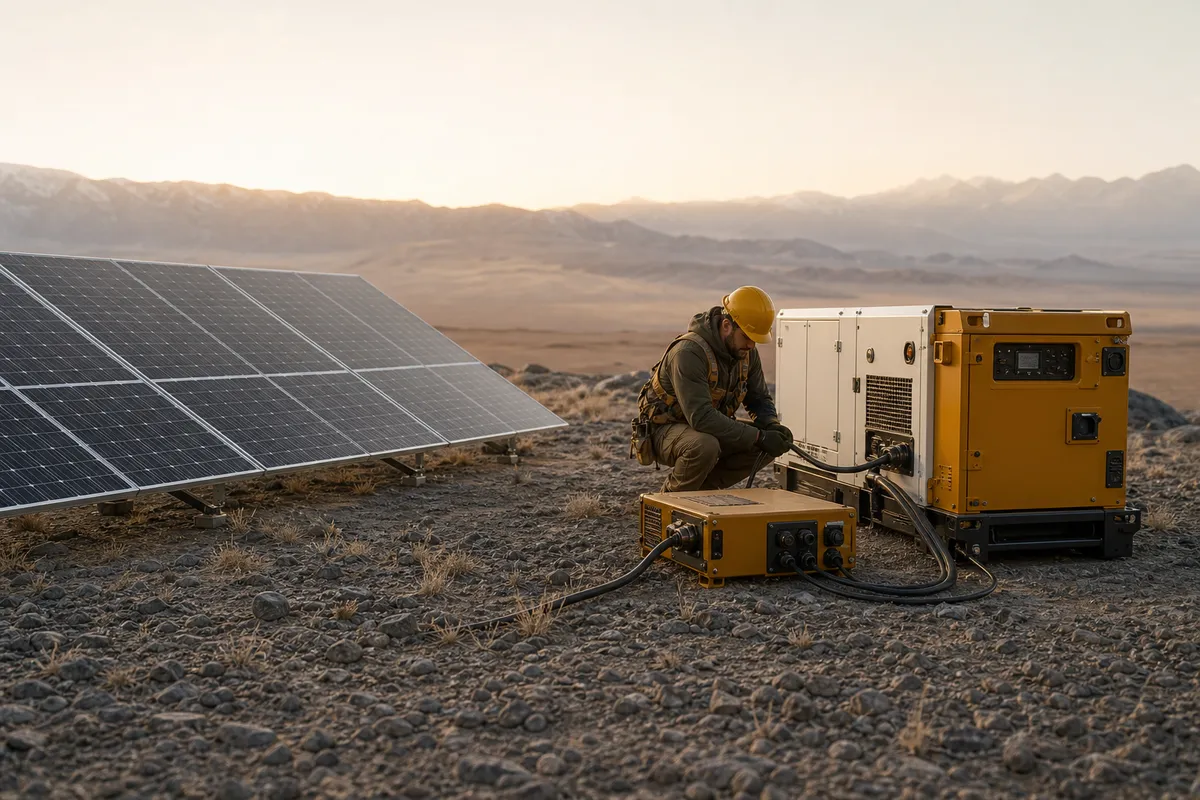
How to Integrate Solar Power: System Types and Architecture
Solar integration architecture falls into three categories: grid-tied, off-grid, and hybrid, and for field operations, the hybrid model is the only one that reliably handles intermittent or absent grid access.
Grid-Tied vs. Off-Grid vs. Hybrid: Which Architecture Fits Your Operation
Grid-tied systems feed solar output directly to the utility network. They cost less to install, but they shut down when the grid goes down, a critical failure point on any remote or regulated site. Off-grid systems are fully islanded, relying entirely on battery storage and whatever generation source is available; they work, but they demand precise load forecasting and leave no fallback if storage depletes.
Hybrid architecture solves both problems. A multi-input system accepts solar, alternator, grid, and generator power simultaneously, whichever source is available charges the battery and serves the load. For construction sites, mining operations, and forward operating bases where grid access is intermittent, this redundancy is the deciding factor.
Power tier selection is the first architectural decision you make when planning how to integrate solar power into a field deployment. Portable units like the Hybridps Batt Pack Energy 3kW, Pro 5kW, and Jupiter 7kW suit distributed or mobile loads. For basecamp or site-wide integration, the Spark Cube 12/24kW and TERRA 167 kVA / 162 kWh platform cover large-scale hybrid microgrid requirements.
For defence applications, solar-primary hybrid systems carry an additional advantage: reducing generator run hours cuts both fuel logistics burden and detectable heat and acoustic output, two signature concerns on any tactical site.
How Battery Storage Integration Works with Solar in a Multi-Input System
LiFePO4 (lithium iron phosphate) chemistry changes the integration calculus compared to generic lithium-ion. It maintains stable thermal behaviour at -30°C, tolerates deeper discharge cycles without accelerated degradation, and carries a safer chemical profile for enclosed or mobile platforms, all critical properties for systems deployed in Canadian winters or aboard vehicles.
A hybrid multi-input inverter/charger continuously monitors available sources and applies load priority logic to decide which input charges the battery and which serves active loads. When solar output is sufficient, the system draws from panels first. When it drops, cloud cover, night, or panel damage, the controller switches automatically to alternator, grid, or generator without interrupting the load. This automatic source switching is what makes continuous runtime achievable on remote sites where no single input is guaranteed.
Assess Your Site Load and Select the Right Equipment
Match your equipment tier to your load profile before designing any solar integration, undersizing the inverter is the single most common cause of integration failure on construction and rental sites.
Start by calculating two separate demand figures: continuous load (the steady draw your equipment runs at hour after hour) and peak surge demand (the spike that motors, compressors, and welders pull at startup). A 5 kW continuous load can surge to 10 kW or more for two to three seconds on startup. If your battery system's inverter tier can't absorb that surge, the system trips, and your site goes dark at the worst possible moment.
Next, inventory every power input already on site. Document whether shore power is available, what your generator's rated output is, and whether vehicle alternators are accessible for opportunistic charging. That inventory tells you how much solar supplementation is realistically achievable versus how much is required to close the gap. A site with reliable grid access needs solar configured differently than a remote forward-operating base with no shore power at all.
Mapping Load Profiles to Power Tiers: Portable Packs vs. Mobile Microgrids
Light distributed loads, hand tools, communications equipment, site lighting, map to the Hybridps Batt Pack Pro 5kW or Jupiter 7kW. Medium basecamp and command post loads, where you're running HVAC, computing, and multiple circuits simultaneously, call for the Spark Cube 12kW or 24kW. Heavy continuous industrial draws and defence forward-operating base deployments require the TERRA at 167 kVA / 162 kWh, which is built to sustain mission-critical loads without interruption.
Cold-weather performance is a hard selection filter for any Canadian or northern deployment. When you plan how to integrate solar power in sub-zero conditions, verify discharge performance at the chemistry and battery management system level, not just the nameplate rating. Hybridps systems use LiFePO4 chemistry with a BMS rated to -30°C, which means the cells and control electronics are validated for that environment, not just the enclosure.
Canadian-made systems with domestic engineering support also reduce procurement risk for defence and government buyers. Supply-chain compliance requirements, increasingly common in federal procurement, are easier to satisfy when the manufacturer, assembly, and technical support are all domestic. That shortens lead times and eliminates the import dependencies that can stall a deployment. For more information, see Enso.
Install and Configure the Solar Integration System
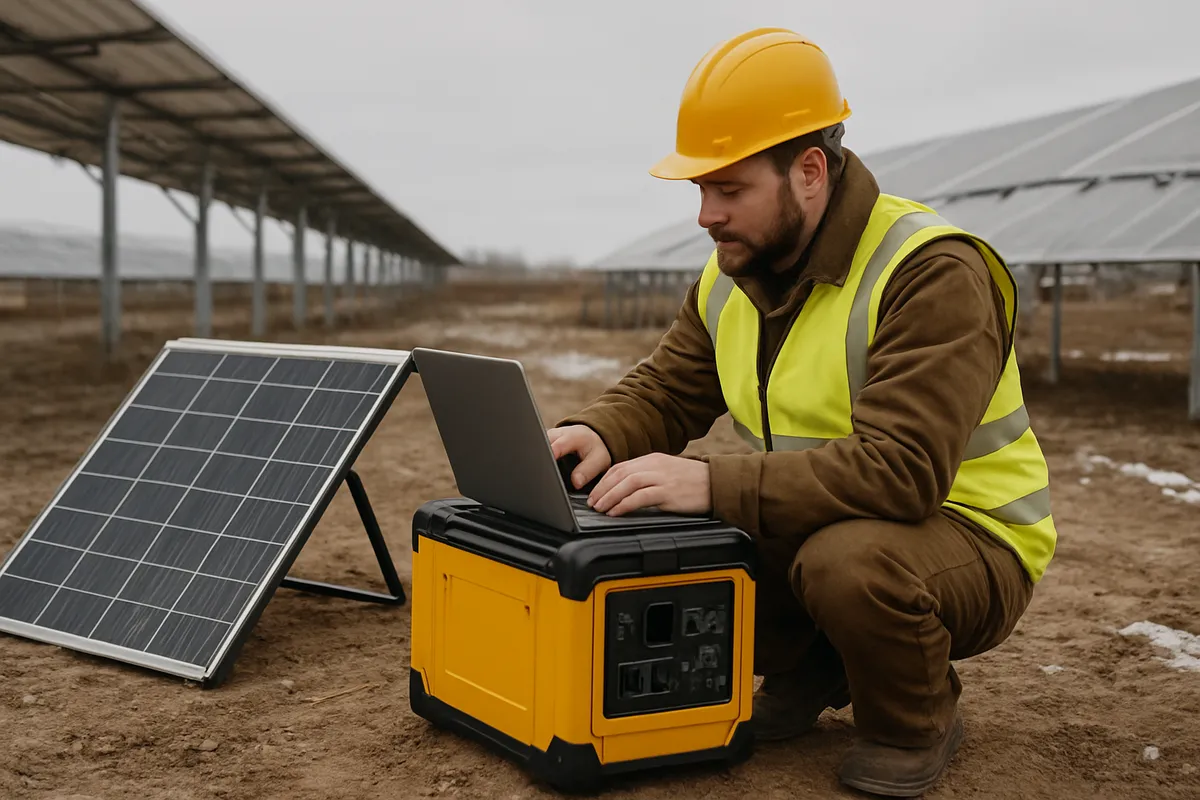
Solar integration follows a fixed sequence: mount panels, run DC cabling to the charge controller, connect to the battery bank, then wire the inverter/charger, verifying each stage before moving to the next.
Start with panel placement. Orient panels south-facing at a tilt angle equal to your site's latitude to maximise irradiance year-round. Before pulling any DC cable, confirm panel output voltage is within the charge controller's rated input window. Run shielded DC cable from the panels to the MPPT charge controller, then connect the controller output to the battery bank terminals. Verify charge controller communication with the battery bank before wiring the inverter/charger, a missed step here is the most common cause of commissioning failures in the field.
Configuring Multi-Input Priority: Solar, Alternator, Grid, and Generator
Set solar as the primary charge source in the inverter/charger configuration menu, then designate grid or generator as the fallback input that activates when solar output drops below a defined threshold. For vehicle-mounted or mobile deployments, a common requirement on construction and defence sites, configure the alternator input as a secondary DC charge source that runs in parallel with solar when the host vehicle is running.
Hybridps systems, including the Batt Pack Pro 5kW and Jupiter 7kW, are engineered for field commissioning without a specialist electrician at the portable tier. The Spark Cube 12/24kW and TERRA 167 kVA / 162 kWh installations require following the published installation documentation at hybridps.ca before energising.
Before the system goes live under load, commission the LiFePO4 battery management system. Verify cell balancing across all cells in the pack, confirm the low-temperature cutoff threshold is active, critical for sites operating near the system's rated -30°C limit, and calibrate state-of-charge to the manufacturer's baseline. A BMS that reads state-of-charge incorrectly will misreport available runtime and can trigger premature low-voltage shutdowns during peak demand.
What the Grid Connection and Synchronisation Process Involves
Knowing how to integrate solar power into a grid-tied hybrid configuration requires meeting two non-negotiable electrical standards: frequency matching (60 Hz in Canada) and voltage matching to the local distribution network. Any deviation outside acceptable tolerances will prevent the inverter from synchronising and may trigger a protective disconnect.
Anti-islanding protection is a regulatory requirement in Canadian jurisdictions, it ensures the system automatically disconnects from the grid during a grid outage, preventing backfeed that could injure utility workers. Most grid-tied inverter/chargers include built-in anti-islanding detection, but the setting must be explicitly enabled and tested during commissioning, not assumed active by default.
Avoid These Common Solar Integration Mistakes
Most solar integration failures trace back to five preventable errors: voltage mismatches, undersized storage, cold-weather oversights, skipped permits, and single-input configurations.
What Causes Inverter Compatibility and Voltage Issues
Pairing solar panels and a charge controller to an inverter with a mismatched voltage window causes clipping losses, or outright system shutdown. Verify that your panel array's maximum power point voltage (Vmp) falls within the charge controller's accepted input range, and that the controller's output voltage matches the inverter's DC input spec, before purchase, not after installation.
Undersizing battery capacity is the second critical error. Operators frequently size storage for a single overnight draw but underestimate how many consecutive low-irradiance days a northern Canadian site can experience. Repeated deep discharge cycles during multi-day overcast periods accelerate cell degradation, particularly in chemistries not rated for that duty cycle. LiFePO4 chemistry handles deep cycling significantly better than standard lithium-ion, which is why Hybridps systems use it across the Batt Pack Energy 3kW, Pro 5kW, and Jupiter 7kW product lines.
Cold-weather derating catches many operators off guard when learning how to integrate solar power for year-round operation. Battery capacity drops in sub-zero temperatures through electrochemical slowdown, while panel output shifts due to irradiance angle changes and snow loading, two distinct mechanisms that compound each other. A system sized for July performance will underdeliver in a Canadian January unless the battery is rated to -30°C and the array is sized with seasonal derating factored in.
How to Prevent Grid Synchronization Failures
Energizing a grid-tied hybrid system without utility notification and inspection sign-off creates serious regulatory exposure. Commercial and defence sites operating under provincial electrical codes, including ESA requirements in Ontario, face stop-work orders, fines, and potential liability if a grid-tied input goes live without the required approvals. File for interconnection review before energizing any grid-connected input, not as an afterthought once the system is running.
Single-input solar-only configurations introduce an operational risk that no mission-critical site should accept. Solar is weather-dependent; on a remote construction site or forward operating base, a three-day overcast period without a fallback source means a power outage. Multi-input hybrid architecture, accepting solar, generator, grid, and alternator charging simultaneously, eliminates that single point of failure. The Hybridps TERRA, rated at 167 kVA and 162 kWh, supports exactly this kind of multi-source configuration for large-scale deployments where downtime is not an option.
Verify System Performance and Plan for Ongoing Operation
After installation, run a structured commissioning check and set up monitoring routines—these two steps determine whether your solar integration holds up across seasons and sites.
Run the Commissioning Checklist
Start with four confirmation points before declaring the system operational:
- Solar input registration: Confirm the MPPT charge controller display shows positive charge current from the panels under direct light. A zero reading in full sun points to a wiring fault or incorrect polarity, not a controller issue.
- Battery state-of-charge trending up: With loads running, the battery state-of-charge should climb during daylight hours. A flat or declining SOC under adequate sun indicates a BMS fault or a mismatch between panel output and load draw.
- Inverter output within spec: Measure AC output voltage and frequency at the load terminals. Deviations outside the inverter's rated tolerance signal a configuration error in the inverter settings, not a panel or battery problem.
- Fallback source switching: Simulate a solar source loss by shading the panels or disconnecting the array. Confirm the system switches to the generator, grid, or alternator input without a break in load power. Hybridps systems—including the Batt Pack Pro and Jupiter—accept multiple charging inputs precisely so this fallback can be tested and relied upon in the field.
Interpret Monitoring Data Without Conflating Subsystems
Underperformance has distinct signatures depending on where the fault sits. Panel soiling or shading reduces input current but leaves voltage relatively stable; a BMS fault typically triggers a protection event logged in the battery management system with an error code; an inverter configuration error shows up as output voltage drift or frequency instability; wiring resistance issues appear as a voltage drop between the source and the controller, measurable with a multimeter across the cable run.
Treat each subsystem's data independently before drawing conclusions. Conflating symptoms—for example, blaming panels for what is actually a high-resistance connection—leads to unnecessary replacements and missed root causes.
Recalibrate for Canadian Seasonal Variation
Solar yield in Canada drops significantly between summer and winter due to lower sun angles and reduced daily irradiance hours—particularly at latitudes above 50°N. Rather than accepting reduced runtime during low-yield months, adjust your generator or grid fallback scheduling to run earlier in the day and top up the battery before the solar contribution drops off in the afternoon. Reviewing monthly yield data from your charge controller lets you set these schedules proactively rather than reactively.
Prepare for Redeployment on Construction and Rental Sites
Knowing how to integrate solar power across multiple project sites requires a redeployment checklist as disciplined as the initial commissioning. Before moving a system, inspect all MC4 and DC connector terminations for corrosion or loosening from vibration, perform a BMS state-of-charge reset to clear accumulated cell-balance drift, and check panel mounting hardware for structural integrity. Skipping these steps between deployments is the most common cause of integration failures on the second or third site. Rental and construction buyers can review fleet planning options on the Buy or Rent page and the Batt Pack Pro and Jupiter product pages.
Defence operators running extended forward-operating deployments should consult the TERRA and Mobile Hybrid Microgrid pages for guidance on multi-input configuration, acoustic signature management, and sustained off-grid runtime at -30°C.
Frequently Asked Questions
Can a hybrid solar system operate in temperatures below -20°C?
Yes, Hybridps battery systems are rated and tested for operation down to -30°C, making them suitable for Canadian winters and remote northern deployments. LiFePO4 chemistry handles cold better than standard lithium-ion, but charge acceptance does slow at extreme temperatures. Systems with integrated thermal management maintain safe operating parameters without requiring manual intervention or warm-up procedures before deployment.
What permits or inspections are required to connect a solar hybrid system to the grid in Canada?
Grid-tied solar installations in Canada require an electrical permit, a licensed electrician for the final connection, and a utility interconnection agreement before energising. Requirements vary by province: Ontario follows the Ontario Electrical Safety Code, while Alberta uses the Canadian Electrical Code with provincial amendments. Your utility will also require a net metering application if you plan to export excess solar generation. Off-grid systems avoid most of these steps but still require a building permit in many jurisdictions.
How does solar integration reduce fuel logistics burden for defence or remote deployments?
Solar charging cuts the frequency of fuel resupply runs by topping up battery reserves during daylight hours, reducing diesel consumption without changing the operational footprint. For forward operating bases or remote sites where fuel convoys carry significant cost and risk, even a partial solar offset meaningfully extends the interval between resupply cycles. Hybridps systems accept solar alongside generator, grid, and alternator inputs, so charging continues regardless of which source is available.
What is the difference between a portable solar battery pack and a mobile hybrid microgrid for construction sites?
A portable solar battery pack, such as the Hybridps Batt Pack Pro 5kW or Jupiter 7kW, powers individual tools or equipment at a single location and recharges via solar panels, alternator, or grid. A mobile hybrid microgrid, like the Hybridps TERRA 167 kVA / 162 kWh, distributes power across multiple loads simultaneously and supports an entire site's electrical demand. The right choice depends on your total connected load, runtime requirements, and how many circuits you need to feed concurrently.
How long does it typically take to commission a solar hybrid system on a new site?
Commissioning time depends on system scale and site conditions. Portable units like the Batt Pack Pro 5kW or Jupiter 7kW can be operational within a few hours once panels are positioned and cabling is run. Larger installations such as the Spark Cube 12/24kW or TERRA 167 kVA require more structured commissioning, including BMS calibration, multi-input priority configuration, and grid synchronisation checks where applicable. Preparing a site load inventory and input source documentation in advance significantly reduces time on-site during setup.
Conclusion
Integrating solar power into an industrial or remote site system comes down to three decisions: sizing your storage correctly for the load and the location, selecting a battery chemistry, LiFePO4, that holds up in cold environments, and configuring multi-input charging so the system keeps running when solar alone isn't enough. Get those three right, and fuel costs drop, noise violations disappear, and resupply logistics shrink.
As a concrete next step, document your site's peak load in kilowatts and your average daily runtime hours, then contact Hybridps directly at hybridps.ca with those figures. A configured quote requires real numbers, that preparation cuts the back-and-forth and gets you to a deployable system faster.