

Products
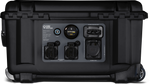 Batt Pack Energy | 3kW
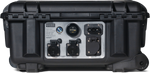 Batt Pack Pro | 5kW
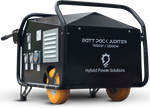 Batt Pack Jupiter | 7kW
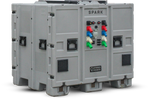 Spark Cube | 12kW/24kW
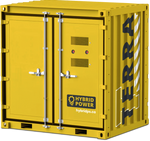 TERRA | 166kVA
Resources

Compare Hybrid Generator Fuel Savings and Emissions on Site
Understanding compare hybrid generator systems for construction and industrial sites fuel savings and emissions is essential. Hybrid generator systems cut fuel consumption and emissions on construction and industrial sites by letting a LiFePO4 battery pack carry the load while the diesel engine idles, downsizes, or shuts off entirely, rather than running continuously at low load like a diesel-only unit. The battery absorbs demand spikes and supplies baseline power overnight or during light-load periods, so the generator only fires to recharge the pack or cover peak draw. Multi-input designs that also accept solar and grid power compound these savings further, while lower engine runtime directly reduces fuel burn, particulate emissions, noise, and maintenance intervals.
How Do Hybrid Generator Systems Compare to Diesel-Only Units on Fuel Savings and Emissions?
The gap comes down to engine runtime: a diesel-only unit runs continuously to meet peak demand, while a hybrid system lets a battery carry the load so the engine runs only a fraction of the time. That single difference drives most of the fuel, emissions, and noise advantage sites see when they compare hybrid generator systems for construction and industrial sites fuel savings and emissions against conventional diesel setups.
What Role Does Battery Energy Storage Play in Reducing Diesel Engine Runtime and Fuel Consumption on Site?
A LiFePO4 battery pack absorbs the short-term spikes and dips in site power demand, then discharges to cover baseline loads like lighting, welfare units, or security systems without the engine running at all. This matters because diesel generators are inefficient at low load, a unit running at 25% load burns significantly more fuel per kilowatt-hour than the same engine at 75% load, and extended low-load operation causes wet-stacking, where unburned fuel and carbon foul the engine and accelerate maintenance needs [1].
Diesel-only generators are typically sized for the site's peak draw, a crane start, a welder cycling on, a compressor kicking in, which means the unit spends most of its life oversized and underloaded for whatever the site actually needs at any given moment [2]. A hybrid system flips that sizing logic: the generator or diesel component is sized closer to the site's average load, with the battery pack absorbing the peaks. Products like Batt Pack Pro 5kW or Jupiter 7kW exist specifically to sit between a generator and the load, smoothing demand so the engine isn't forced to run oversized around the clock.
How Do Multi-Input Hybrid Systems Compound Fuel and Emissions Savings Over a Project?
Multi-input hybrid architecture lets the battery recharge from whichever source is cheapest or available on site, solar during daylight, grid power where a connection exists, an alternator from a working vehicle, or the generator only when nothing else is on hand. Over the length of a project, that flexibility compounds: industry reporting on UK construction sites found hybrid systems combining batteries with smaller generators typically cut fuel consumption by 50–70%, while sites with grid access running battery energy storage systems reported fuel savings approaching 90% with zero on-site emissions [2]. Mobile hybrid battery energy storage paired with a generator has also been shown to reduce fuel consumption, emissions, and operating costs without sacrificing reliable off-grid power [3].
Fewer engine hours translate directly into less particulate matter and NOx output, but the logistics side matters just as much for remote and defence sites: less diesel burned means fewer fuel deliveries, smaller convoys, and a lower acoustic and thermal signature, a fuel-logistics benefit that often outweighs the emissions case for forward-deployed teams. None of this holds up without the right battery chemistry. LiFePO4 is what allows daily deep cycling over years of field use without the capacity fade that would erode these savings, a distinction that matters more than generic lithium-ion branding suggests.
What Is the Real Total Cost of Ownership for Hybrid Versus Diesel Over a Multi-Year Project?
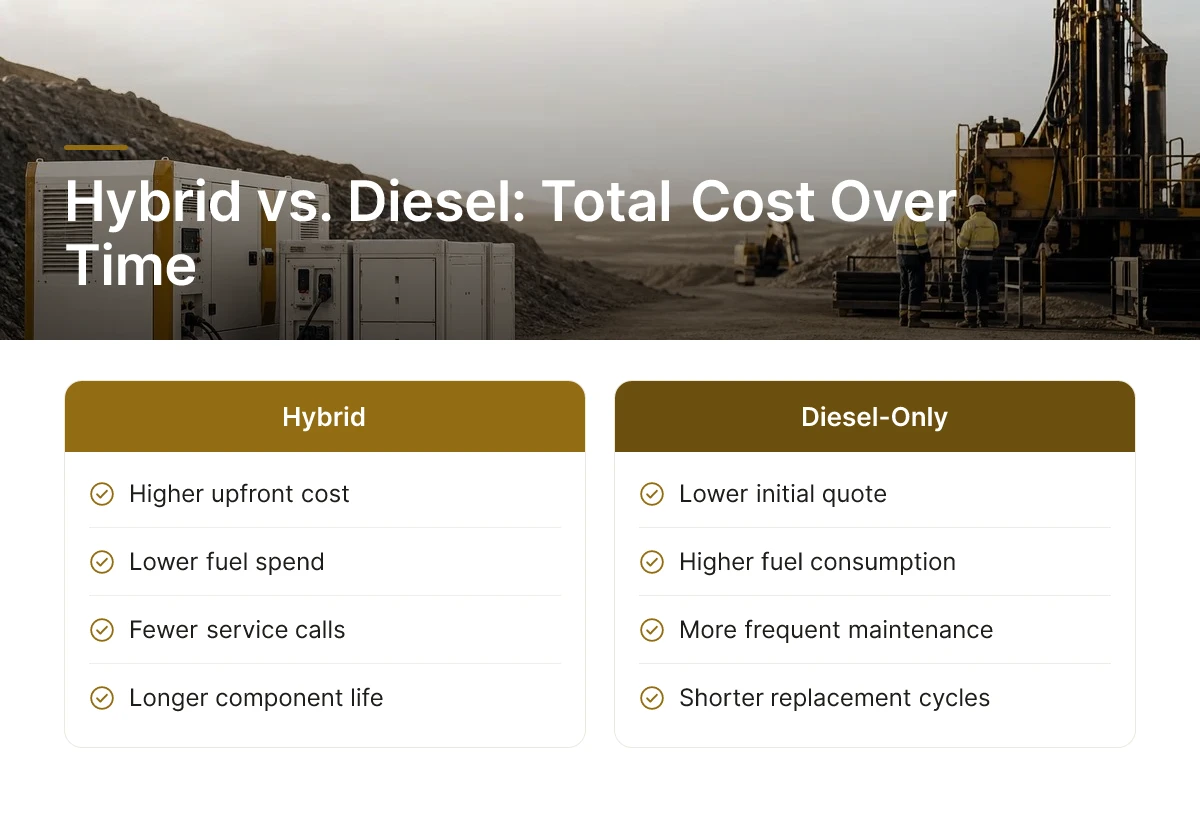
Hybrid TCO looks higher on a quote and lower on a multi-year ledger, fuel savings, fewer service calls, and longer component life offset the upfront cost over time.
When buyers compare hybrid generator systems for construction and industrial sites fuel savings and emissions against diesel-only fleets, the sticker price tells almost nothing. The real comparison runs across four line items: fuel spend, maintenance intervals, battery or engine replacement cost, and compliance exposure. Diesel-only units lose on the first two immediately, a generator running at 25% load burns disproportionately more fuel per kilowatt-hour than one running near 75% load, and that inefficiency compounds daily over a multi-year contract [1]. Maintenance follows the same pattern: oil changes, filter swaps, and engine wear accumulate on a fixed schedule regardless of how efficiently the unit is actually loaded. Hybrid systems shift the cost structure. The engine (where one exists) runs fewer hours because the battery carries variable loads, which stretches service intervals and cuts the number of callouts a site needs over a contract's life [4]. Compliance costs, fines, monitoring, idle-time restrictions, also shrink or disappear where emissions and noise limits apply to job sites.
What Are the Battery Degradation Rates, Replacement Costs, and Warranty Terms for LiFePO4 Hybrid Systems Deployed Long-Term?
LiFePO4 batteries hold a longer cycle life than other lithium chemistries, which changes the replacement-cost math across a multi-year deployment. A chemistry that degrades faster forces an earlier mid-contract replacement, an expense that erases much of the fuel savings a hybrid system was supposed to deliver. LiFePO4's chemical stability means fewer replacement cycles across the same deployment window, which is why Hybridps builds its Batt Pack Energy, Pro, and Jupiter lines, along with the TERRA hybrid microgrid, on this chemistry rather than generic lithium-ion. Warranty terms and duty-cycle ratings are the actual determinants of long-term cost here, not the upfront number on a quote, buyers should check the published specs at hybridps.ca rather than estimate degradation on assumption.
How Quickly Does a Hybrid System Pay for Itself Through Fuel, Maintenance, and Compliance Savings?
Payback builds gradually: fewer fuel deliveries, fewer technician visits, and less downtime risk each chip away at the cost gap until the hybrid system overtakes diesel-only spend. None of these savings show up as one dramatic line item, they stack weekly, then monthly, until the crossover point arrives. Sites running hybrid-battery combinations instead of generator-only setups have reported cutting fuel consumption meaningfully while improving reliability and lowering operating costs [3].
Scale changes which product tier makes sense. A budget-friendly portable Batt Pack Energy unit suits a single-crew job site with modest loads; the mid-range Batt Pack Pro or Jupiter steps up for larger equipment runs; a premium site-scale system like TERRA, rated at 167 kVA continuous, fits a multi-crew or forward operating base footprint where fuel-logistics reduction matters more than unit price. Matching the tier to the load avoids both overspending and undersizing.
How Do You Size and Configure a Hybrid Generator System for Your Site's Power Demands?
Size a hybrid system to your site's actual average load, not the sum of nameplate ratings on every tool you own, then layer in solar, grid, or alternator charging to cover the gap. Buyers who compare hybrid generator systems for construction and industrial sites fuel savings and emissions without doing a load audit first usually end up oversized, overspent, or both.
What Is the 80% Rule and How Does It Change the Way You Select a Hybrid Power System?
The 80% rule means sizing a power system to roughly 80% of continuous average demand, not peak nameplate draw, because peak loads happen briefly while most equipment runs well below its rated maximum most of the day. A diesel-only generator sized for worst-case peak spends most of its life running at a fraction of load, and fuel efficiency drops sharply at low load, a generator running at 25% load burns significantly more fuel per kilowatt-hour than one running at 75% [1]. A hybrid system flips that math: the battery absorbs short peaks while a smaller, right-sized generator or grid connection covers steady-state demand.
Start with a basic load audit. List every tool and piece of equipment on site, note its duty cycle, how often it actually runs versus sits idle, and separate daytime peak loads (saws, welders, compressors) from overnight standby loads (lighting, security, telemetry, site trailers). Overnight loads are often a small fraction of daytime peaks, and sizing for peak alone wastes fuel burning a full-size generator to power a security light.
How Do You Integrate Solar, Grid, and Alternator Inputs to Maximize Uptime and Minimize Diesel Dependency?
Layer in solar panels for daytime recharge, grid power where available, and vehicle alternator charging during transit or idle equipment time, each input reduces how often the diesel generator has to run. Hybrid systems that combine batteries with smaller generators typically cut fuel consumption by 50–70%, and where grid access exists, battery storage alone can push savings toward 90% with zero on-site emissions during operation [2]. Multi-input charging means the diesel component becomes a backup rather than the primary source, which is the core shift from hybrid generator to hybrid power system.
Hybridps maps power tiers directly to load profiles. The Batt Pack Energy 3kW, Pro 5kW, and Jupiter 7kW cover hand tools and small equipment on a crew-level job site. Spark Cube 12/24kW steps up to mid-size site power, welfare units, lighting towers, multiple trade stations running concurrently. TERRA, rated at 167 kVA continuous, handles whole-site or microgrid-scale demand where a construction project or forward operating base needs sustained, multi-load power without a central generator running non-stop.
Deployment speed matters as much as capacity. A Spider Box distributes load to multiple points without rerunning cable runs across an active site, and a Towable Trailer Mount lets crews relocate the unit as work zones shift, both reduce setup time when a project moves faster than the power plan.
What Performance Gains Do Hybrid Systems Deliver in Extreme Weather and Mission-Critical Applications?
Extreme-cold starting reliability, low noise and heat signature, and easier emissions-tier compliance are the three gains that separate hybrid systems from diesel-only units under field stress.
How Do Hybrid Systems Rated for -30°C Perform on Remote Industrial and Defence Sites Where Reliability Is Non-Negotiable?
Diesel fuel can gel below freezing, and cold engine blocks are a well-known source of failed starts on northern job sites and forward operating bases. A battery system rated to -30°C, such as the Hybrid Power Solutions Batt Pack line, sidesteps that failure mode entirely, there's no fuel to gel and no combustion cycle that needs to reach operating temperature before it delivers full power.
For defence logistics teams, that reliability has a second payoff: fewer fuel resupply convoys into contested or hard-to-reach terrain. A forward operating base running on battery power with solar, alternator, grid, or generator charging inputs needs less diesel moved in, which shrinks the convoy's exposure window and the fuel logistics burden overall. For construction crews in Canada's north, it means equipment that starts the first time, every time, without pre-heating routines or standby generators burning fuel just to stay warm.
What Regulatory Compliance Standards Do Modern Hybrid Systems Help Sites Meet?
Hybrid systems help sites meet tightening emissions and noise rules because shorter engine runtime and cleaner combustion cycles produce fewer regulated pollutants per hour of site power. Diesel units that idle at partial load, common overnight or during low-demand periods, burn fuel inefficiently and generate disproportionate emissions relative to the work performed [1]. A battery that carries the base load and only calls on a generator for peak demand or recharging cuts that wasted runtime directly, which makes meeting standards like EPA Tier 4, CARB, and EU Stage V more achievable without derating the equipment.
Low acoustic and thermal signature matters well past defence applications. Urban job sites with noise bylaws, environmentally sensitive locations near wildlife or waterways, and any site running night shifts all benefit from equipment that doesn't announce itself. Silent battery operation can shorten the back-and-forth with regulators and permitting bodies, since noise and emissions variances are often the slowest part of a compliance review.
When teams this strategy, the extreme-weather and regulatory performance gap is often as decisive as the fuel bill, reliability in the field is what makes mission-critical deployments possible at all, not just more comfortable.
How Do Portable, Mobile, and Site-Scale Hybrid Configurations Compare for Professional Field Operations?
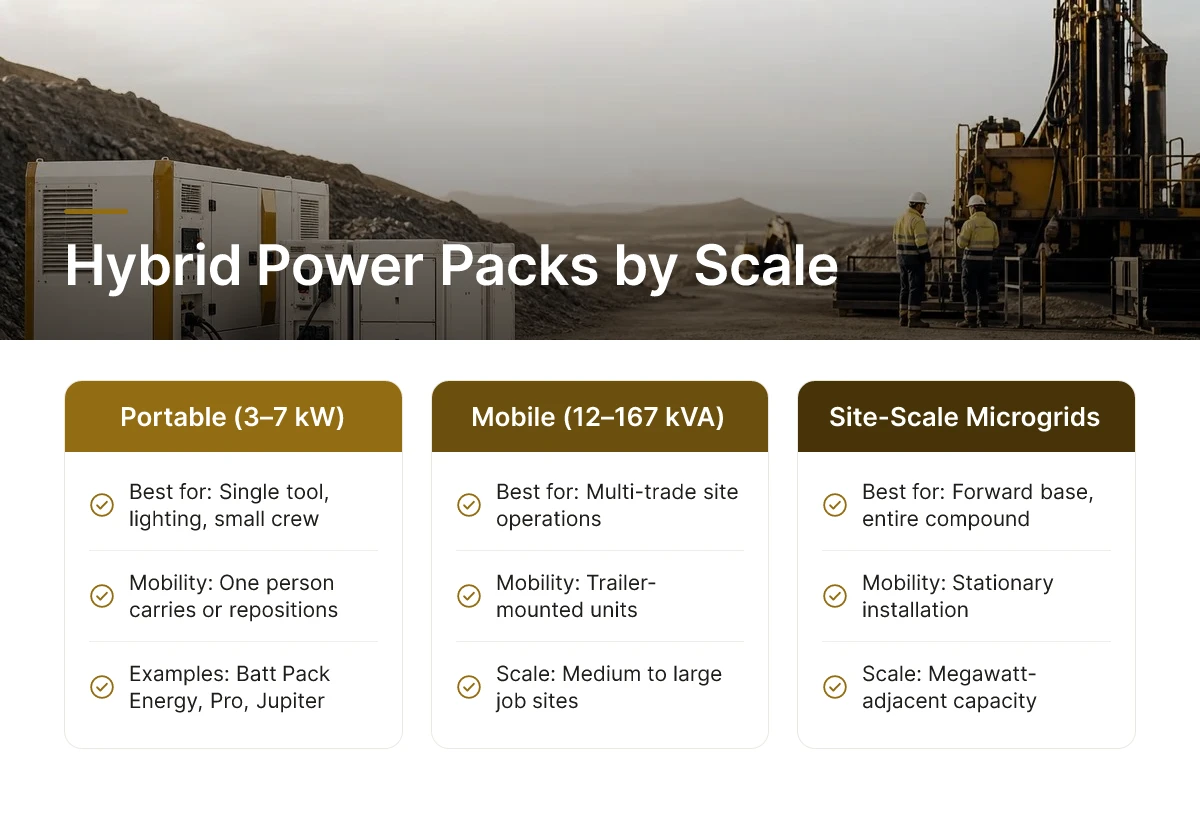
Power tier should match the job: single-tool portable packs for one crew, trailer-mounted units for a multi-trade site, and megawatt-adjacent microgrids for a forward operating base or an entire compound.
How Do Portable Hybrid Power Packs (3-7 kW) Compare to Stationary and Mobile Hybrid Systems (12-167 kVA)?
Portable packs in the 3-7 kW class cover tool power, lighting, and small-crew needs where one person needs to carry, load, or reposition the unit without a forklift. The Batt Pack Energy (3kW), Batt Pack Pro (5kW), and Batt Pack Jupiter (7kW) sit in this tier, built for job-box-scale loads and quick redeployment between work zones.
Stationary and mobile systems step up to whole-site or whole-building scale. A Spark Cube at 12 or 24 kW handles a trailer compound, a welfare block, or a medium equipment yard. At the top end, a TERRA hybrid microgrid delivers 167 kVA continuous and 250 kVA peak from 162 kWh of storage, enough to run cranes, pumps, and camp loads simultaneously, something no briefcase-class battery pack is designed to attempt. Buyers who this approach need to weigh load profile first, because undersizing a portable pack against a crane or compressor load defeats the purpose of going hybrid at all.
Deployment speed moves in the opposite direction of capacity. A single operator can unload and energize a portable pack in minutes, while a towable trailer-mount or site-scale microgrid needs siting, cabling, and commissioning time, a reasonable trade for continuous, whole-site power instead of single-circuit coverage.
What Acoustic and Thermal Signature Advantages Do Hybrid Systems Provide on Noise-Restricted Job Sites?
Low acoustic and thermal signature keeps crews working on noise-curfewed sites and keeps equipment less detectable in defence and perimeter-sensitive deployments. On urban construction sites with evening noise bylaws, a battery-fed load avoids the generator run that would otherwise violate curfew. On a forward operating base, the same quiet, cool-running profile reduces how far a unit can be heard or thermally spotted, a factor that matters as much as fuel burn or emissions reporting.
Multi-input charging, solar, alternator, grid, or generator, keeps every tier running continuously rather than depending on a recharge window, which separates hybrid systems from battery-only portable units that stop producing power once depleted [3]. A rental fleet or construction supervisor gets the same logic at smaller scale: charge opportunistically, run quietly, and avoid scheduling downtime around a dead battery.
Hybrid Power Solutions designs and assembles its full range, from Batt Pack units to TERRA, in Canada, giving defence, government, and rental-fleet buyers direct supply-chain control and procurement traceability that imported battery-only systems can't match.
Frequently Asked Questions
Can a hybrid generator system fully replace a diesel-only generator on a construction site?
Often yes for variable loads, but sizing matters more than the marketing term "hybrid." A battery system like Batt Pack Pro 5kW or Jupiter 7kW can carry overnight security, lighting, and tool loads on battery alone, recharging from solar or a smaller generator during the day. Peak crane or welding loads on larger sites may still need a hybrid microgrid like TERRA rather than full diesel elimination.
Do hybrid generator systems need less maintenance than diesel-only units?
Yes, fewer running hours on the engine component means less wear on moving parts. A battery bank has no oil changes, filters, or wet-stacking issues [2], so maintenance shifts from scheduled engine service to periodic battery and inverter checks, which are typically less frequent and less labour-intensive.
How does LiFePO4 battery chemistry affect long-term reliability compared to other lithium batteries?
LiFePO4 (lithium iron phosphate) runs cooler and degrades slower than other lithium chemistries, which matters for sites that cycle batteries daily for years. It's more thermally stable, reducing fire risk in enclosed job-site storage, and typically delivers more charge cycles before capacity drops off. Hybridps uses LiFePO4 across its Batt Pack and Spark Cube lines specifically for this cycle-life and safety margin in field conditions.
Are hybrid generator systems reliable enough for remote or off-grid industrial sites?
Yes, when the system is rated for the site's climate and sized with enough continuous and peak capacity. Multiple charging inputs, solar, alternator, grid, or generator, mean the battery bank isn't dependent on any single fuel source arriving on schedule. Hybridps systems are rated to -30°C, which matters for Arctic, northern, and winter-construction deployments where cold-starting a diesel unit becomes its own reliability problem.
What size hybrid system does a typical mid-size construction site need?
It depends on simultaneous load, but many mid-size sites fall between the Batt Pack Jupiter 7kW and Spark Cube 12/24kW range. Sites running cranes, welfare units, and tools together may need Spark Cube or a small hybrid microgrid; lighter sites with staggered loads can run on a single Jupiter unit with solar top-up.
Conclusion
Fuel savings and emissions reductions from hybrid generator systems come down to three factors: load matching, charging flexibility, and duty cycle. A diesel generator sized for peak load but running at 25% load most of the day burns fuel inefficiently [1]; a battery bank sized to the real load profile, recharged from solar, grid, or a smaller generator, closes that gap. Before replacing or augmenting a diesel fleet, pull your site's actual load data for a representative week. Match it against the Batt Pack, Spark Cube, or TERRA specifications published at hybridps.ca, and request a demo configuration sized to that load rather than to nameplate peak demand.
Sources & References
- Hybrid Generator vs. Diesel Generator Comparison - Cost, Efficiency & Performance
- Construction Site Power Solutions: Complete Guide to Generators, Hybrid & Battery Systems - WOLFF Onsite
- Mobile Hybrid BESS vs Diesel Generators Comparison
- Atlas Copco launches Integrated Hybrid Generator range to help cut fuel use, emissions and operating costs - Atlas Copco USA
Recommended Articles
Explore more from our content library: