

Products
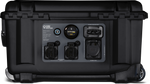 Batt Pack Energy | 3kW
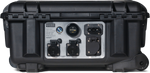 Batt Pack Pro | 5kW
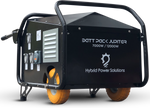 Batt Pack Jupiter | 7kW
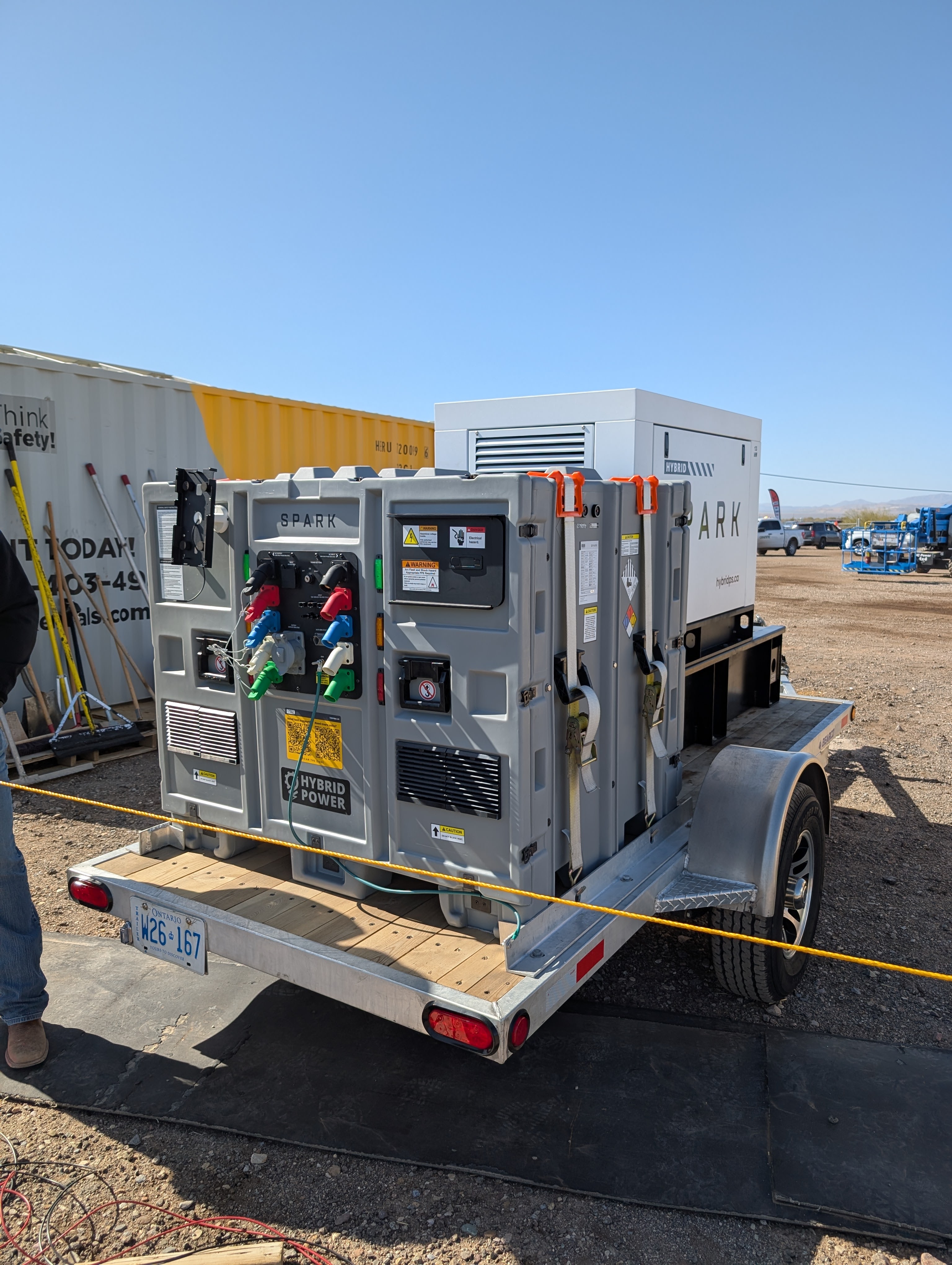
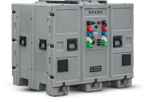 Spark Cube | 12kW/24kW
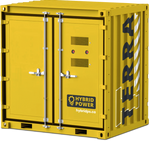 TERRA | 166kVA
Resources

A Buyer's Guide to the Most Reliable Backup Generator

The most reliable backup generator for business and defence operations is a hybrid system that pairs LiFePO4 battery storage with multi-input charging (solar, alternator, grid, generator) rather than a diesel-only unit. Reliability in mission-critical settings comes from redundancy and reduced moving parts, not fuel volume alone, fewer refuelling runs mean fewer failure points. For multi-day, off-grid, or extreme-temperature deployments, systems rated to -30°C with continuous hybrid runtime outperform diesel-only generators on uptime and total cost of ownership.
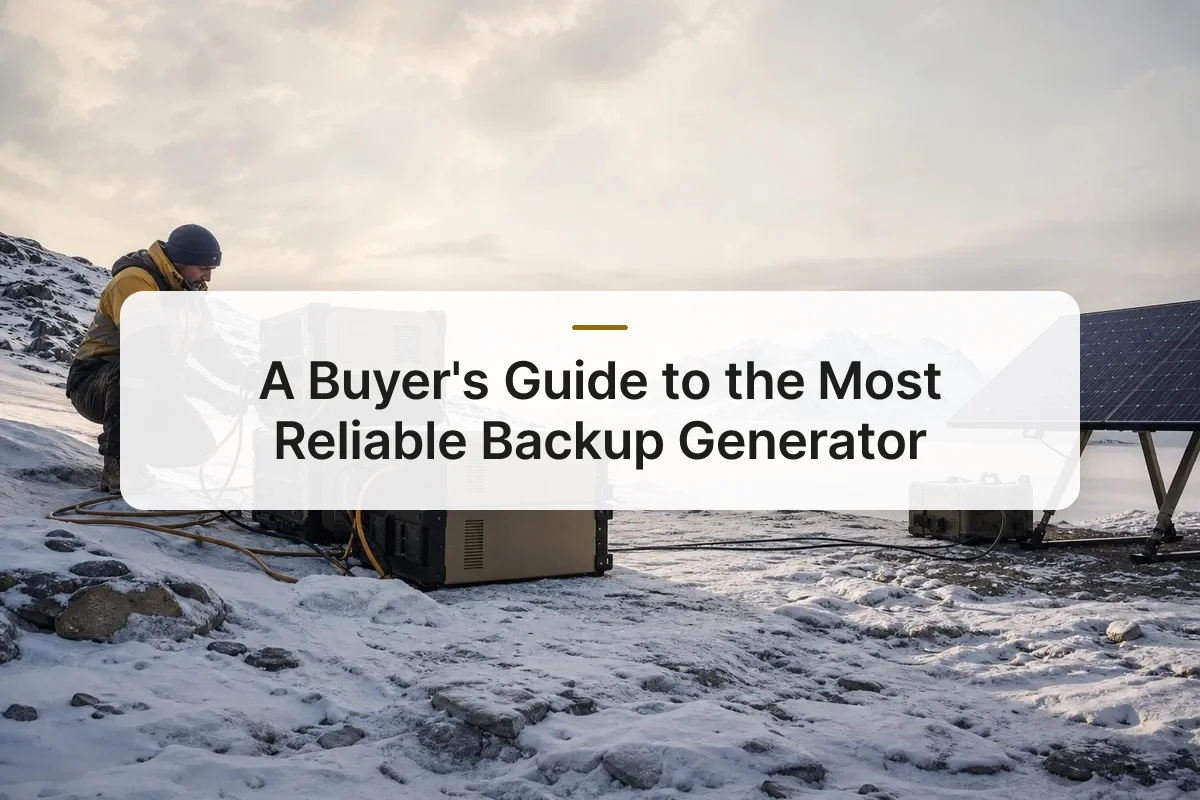
1. Hybrid Battery Microgrids: The Most Reliable Backup Generator Category for Mission-Critical Sites
For defence, industrial, and rental operators, the most reliable backup generator isn't the one with the longest run-hours on a single tank, it's the one that never runs out of options. Reliability means uptime combined with fuel-logistics independence, not just tank capacity.
A diesel-only standby unit has one input and one failure mode: it stops when the fuel stops. Hybrid battery microgrids accept multiple charging inputs, solar, vehicle alternator, grid, and generator, so if one source is unavailable or delayed, the system keeps drawing from another. That redundancy is structural, not a maintenance workaround. For a broader look at how battery storage and generators compare as backup strategies, see this comparison of battery storage, generators, or both.
TERRA, Hybridps's flagship hybrid microgrid, illustrates what this looks like at scale: 167 kVA continuous power, 250 kVA peak, and 162 kWh of storage built for whole-site and multi-day deployments. It's sized for forward operating bases, remote industrial sites, and multi-day construction or disaster-response operations where a single generator failure would halt the mission.
Most competing pages measure reliability in fuel efficiency or decibel levels. What they miss is the single-point-of-failure risk built into any generator-only setup: if the tank runs dry mid-mission and resupply is delayed, power stops. A hybrid microgrid with continuous multi-input charging removes that dependency entirely, which is exactly why it stands out as the most reliable backup generator option for mission-critical sites.
2. Portable LiFePO4 Battery Packs for Job-Site and Field Power
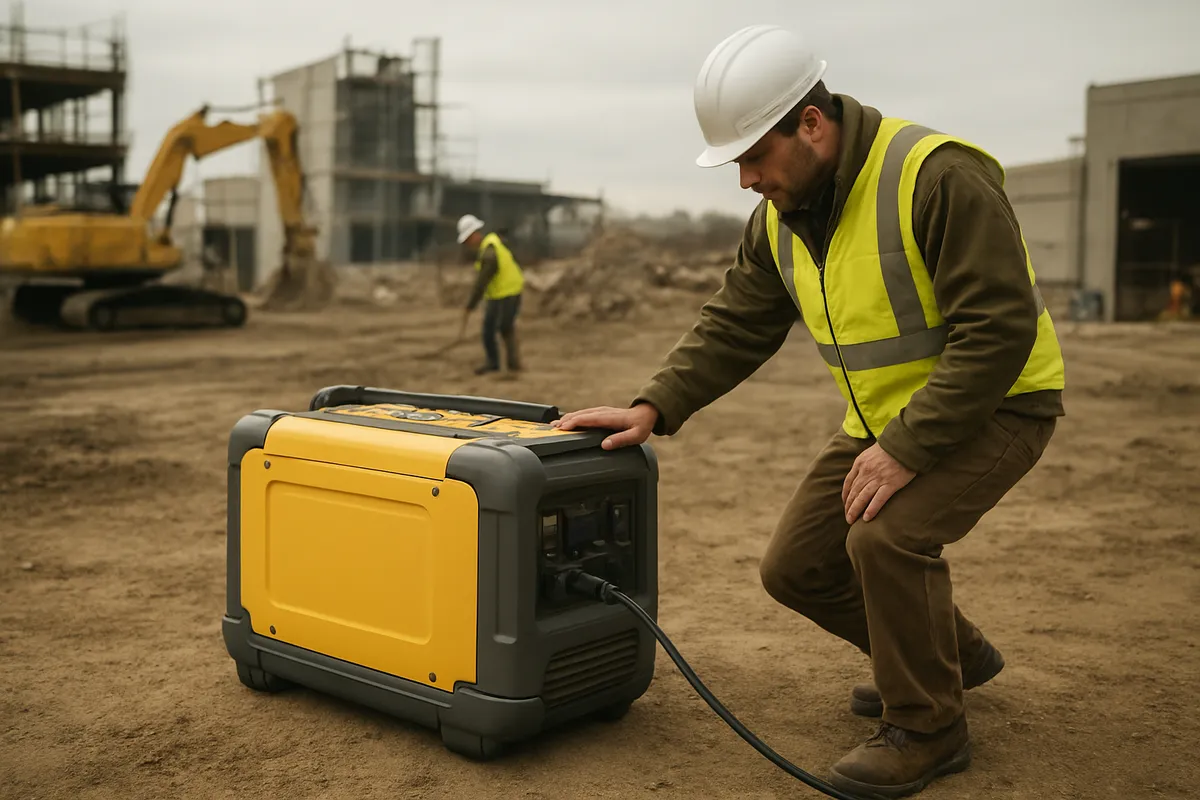
Portable LiFePO4 battery packs deliver silent, fuel-free power at tool scale, built for crews who need overnight job-site power without a fuel delivery schedule.
The Batt Pack Energy 3kW, Batt Pack Pro 5kW, and Batt Pack Jupiter 7kW form this tier. All three use LiFePO4 (lithium iron phosphate) chemistry rather than generic lithium-ion. LiFePO4 holds up better under repeated daily charge cycles typical of job-site use, and it runs cooler and more stable thermally, a meaningful safety margin when packs sit in direct sun or a job-site trailer for weeks at a time.
This tier fits construction crews that need quiet power overnight, tool-scale charging through the day, and no dependency on fuel resupply. It's the entry point for teams replacing a small gas or diesel generator with something that starts cold, every time, with no fuel to manage. For small business owners weighing their options at this scale, this guide to choosing a small business generator covers additional sizing considerations.
The gap versus briefcase-class competitors in this category is capacity: Hybridps's portable line scales up to 7kW continuous, well above the roughly 3.6kW ceiling common to lightweight, single-worker battery packs. For specs and configuration options, see the Batt Pack Pro and Jupiter product pages.
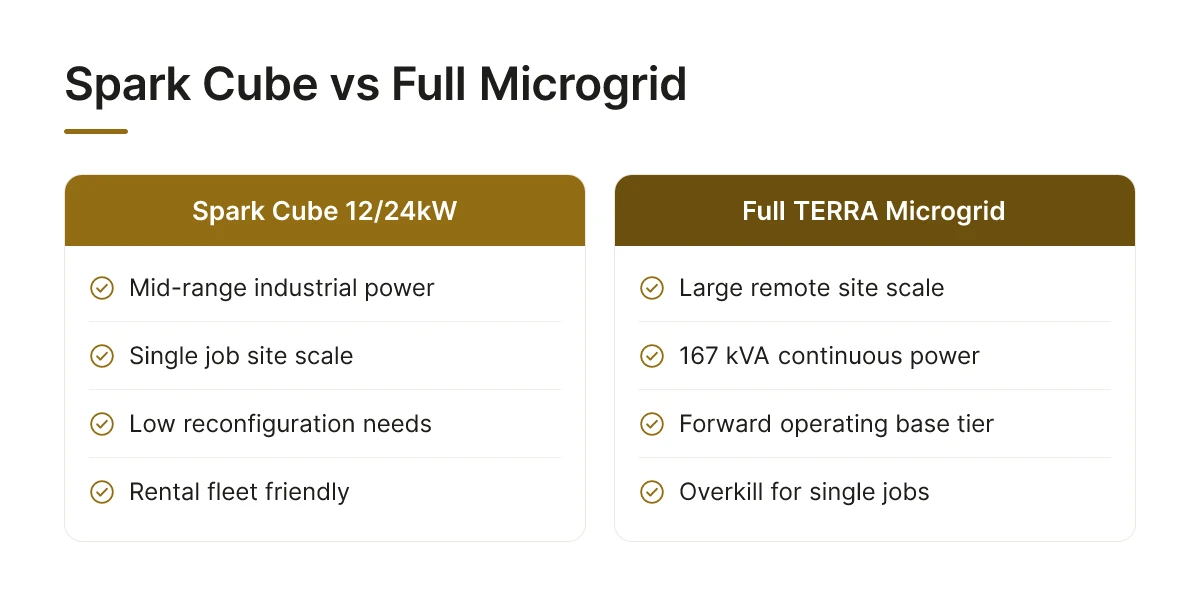
3. Spark Cube 12/24kW for Mid-Size Industrial and Rental Fleets
Spark Cube 12/24kW covers the power gap between portable job-site packs and full microgrids, built for rental fleets and mid-size industrial sites.
A portable pack can't carry a mid-size load, and a full TERRA deployment is overkill for a single job site. Spark Cube sits in between, with modular 12kW and 24kW configurations covering mid-range industrial and commercial power needs without stepping up to microgrid scale.
For equipment rental fleets, it's a fit because one durable, low-maintenance unit can serve several job types without reconfiguration, a crew doesn't need a different generator size for every contract. Buy-or-rent flexibility lets fleet operators scale capacity up or down with seasonal demand instead of carrying idle inventory through slow months.
What most competitor content skips: the modular 12kW/24kW design lets a rental fleet standardize on a single platform rather than stocking multiple generator sizes to cover different customer loads, fewer SKUs, simpler maintenance, and faster fleet turnover. See Buy or Rent and Portable Power Packs for configuration and availability.
4. TERRA Hybrid Microgrid for Forward Operating Bases and Large Remote Sites
TERRA delivers 167 kVA continuous power, 250 kVA peak, and 162 kWh of storage, the top power tier built for forward operating bases and large remote sites.
For defence buyers, the first benefit isn't emissions, it's convoy reduction. Every diesel resupply run into a forward operating base is a logistics cost and a security exposure. By cutting generator runtime and shifting the load to battery storage, TERRA reduces how often fuel convoys need to move, which lowers both operational cost and risk along the supply route. This is part of why hybrid microgrids are increasingly seen as the most reliable backup generator solution for defence-grade deployments, as outlined in this overview of deployable power for mission-critical operations.
TERRA's low acoustic and thermal signature matters operationally, not just for crew comfort. In forward-deployed or sensitive environments, a quiet, cool-running power source is harder to detect than a running diesel generator, a real factor in force protection, not a secondary benefit.
This tier fits forward operating bases, drone recharging stations, and remote site operations that need days-to-weeks of continuous runtime without resupply. The hybrid multi-input design, solar, alternator, grid, and generator, means TERRA keeps running if any single input fails or is delayed, unlike single-source standby systems that stop the moment their one fuel line is cut.
How -30°C Operating Ratings Extend Mission Capability in Northern and Arctic Deployments
Hybridps systems are rated to operate down to -30°C, engineered and tested in Canada for cold-weather field conditions. For northern and Arctic deployments, that rating matters because cold-start failure and fuel gelling are common points of failure for diesel-only equipment in sub-zero conditions. A hybrid system rated for extreme cold keeps running through the same conditions that stall a standard generator, extending mission windows in exactly the climates where failure isn't an option.
5. Water-Cooled Diesel DC Generator for Hybrid Backup Charging
The water-cooled diesel DC generator recharges the battery system as a backup input, it doesn't carry the site's continuous load itself.
In this hybrid architecture, the battery system handles day-to-day power, and the diesel DC unit steps in to recharge storage when solar, alternator, or grid inputs aren't enough. Because the generator runs intermittently to top up batteries rather than continuously to power loads directly, total fuel burn drops and service intervals stretch out compared to a diesel-only standby setup that runs nonstop.
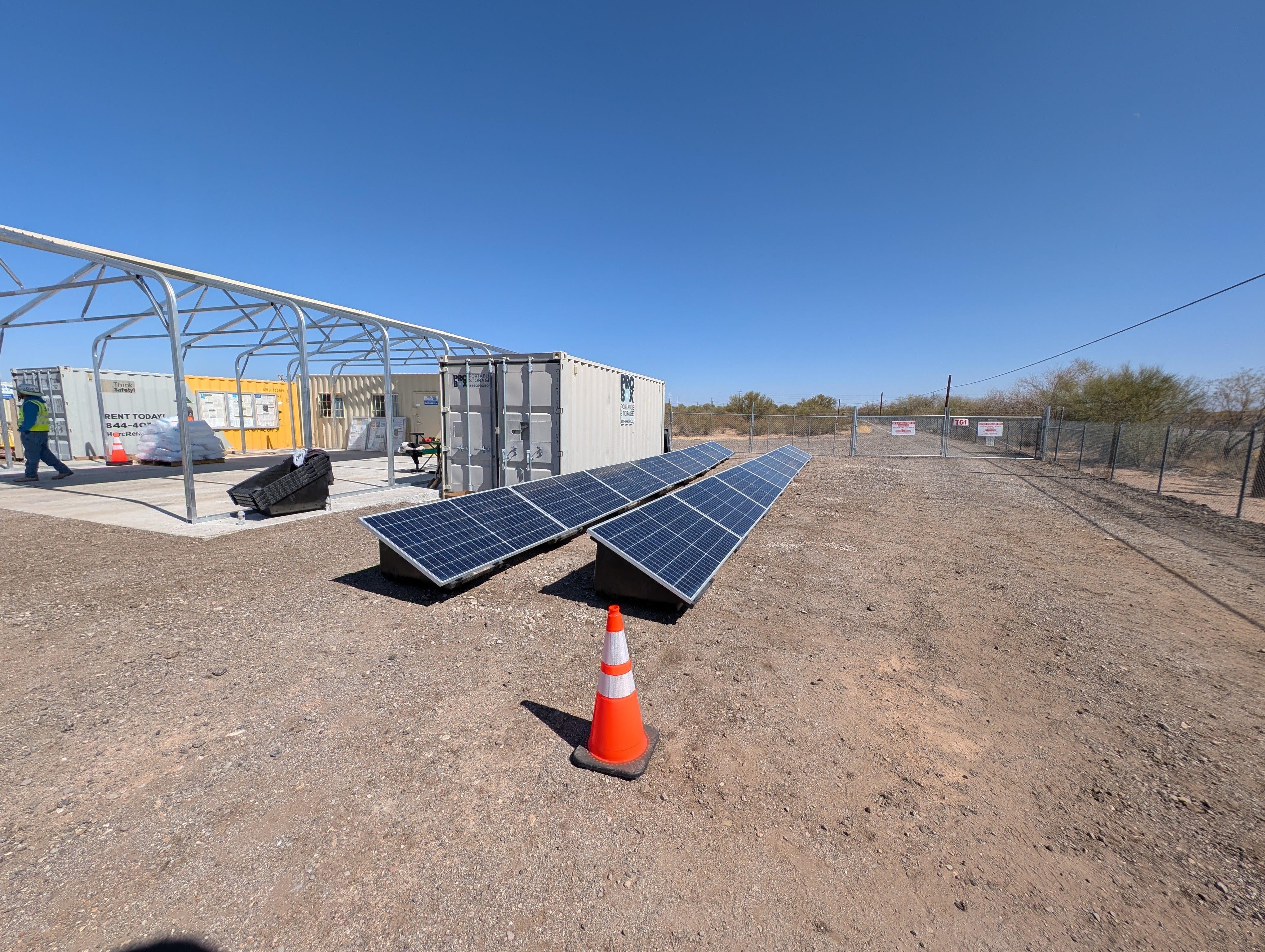
This configuration fits sites that want an extended-runtime fallback alongside battery-primary operation, useful when a deployment runs longer than planned or weather limits solar input for several days. Guides like this hybrid solar-battery and generator resilience blueprint outline similar logic for stacking power sources.
One advantage most comparison pages don't mention: pairing a water-cooled DC generator with battery storage smooths out load spikes. A standalone generator wears down faster when it's constantly ramping to meet sudden load changes; with batteries absorbing the spikes, the generator runs at a steadier load and lasts longer in service.
6. Towable Trailer Mount and Spider Box for Rapid Deployment
A towable, pre-wired hybrid platform gets power running within minutes of arrival, while a standard generator setup requires separate fuel staging, distribution cabling, and grounding before the first load connects.
The Towable Trailer Mount carries the battery system, inverter, and distribution components as a single unit. Crews hook it up, position it, and connect loads, there's no separate fuel tank to stage, no distribution panel to wire from scratch, and no grounding rod to drive before work starts.
The Spider Box handles the second half of the problem: getting power to multiple points across a scattered job site. Instead of running separate feeder cables from a single generator output, the Spider Box splits distribution into multiple protected outlets, so tools, lighting, and site trailers each get a dedicated, breaker-protected connection without daisy-chained extension cords.
Best for
Construction sites and emergency-response teams that need power operational within minutes of arrival, not hours.
The differentiator is plug-and-play hybrid distribution. Many stationary standby systems demand licensed electrical installation before they can carry a load, this setup is built to skip that step entirely.
7. Battery-Primary Hybrid Systems for Extreme-Temperature Reliability
Battery-primary systems rated to -30°C avoid the cold-start failures that make diesel engines the weak link in Arctic and northern deployments.
Diesel generators depend on fuel atomization and combustion temperature to start, both degrade sharply in cold climates, leading to fuel gelling, glow-plug delays, and battery-assist failures at the engine's own starter battery. A battery-primary system has no combustion step to fail. Hybrid Power Solutions builds its battery packs and rated for deployment down to -30°C, with no warm-up cycle required before delivering full output.
LiFePO4 chemistry is the reason this holds at both ends of the temperature range. It maintains stable charge and discharge performance in cold and heat without the output derating that diesel generators experience at altitude or in high-heat enclosures. That thermal stability also extends cycle life compared to other lithium chemistries, which matters for multi-day deployments where recharge cycles stack up fast.
Best for
Canadian northern operations, winter construction, and Arctic or defence deployments where a failed cold start isn't an option.
The differentiator here isn't an accessory. It's chemistry and battery-primary design, not insulation wraps or block heaters bolted onto a generator to compensate for an engine that wasn't built for the climate.
8. Canadian-Engineered Hybrid Systems with Field Serviceability
Domestic engineering and assembly gives defence and government buyers supply-chain control that imported systems and overseas parts networks can't match.
Hybrid Power Solutions designs and assembles its systems in Canada, which shortens procurement timelines and keeps technical support, spare parts, and engineering changes inside the same supply chain buyers are already contracting under. For defence and government procurement, that domestic sourcing matters for audit trails and compliance requirements as much as for lead times.
Field serviceability follows the same logic. Modular components mean a technician can swap a faulty module in the field rather than shipping the entire unit back for repair, and support is reachable without routing through an overseas distributor.
Hybrid Power Solutions is also publicly traded, listed on the CSE, OTCQB, and Frankfurt exchanges, which means its specs and claims carry the disclosure discipline that comes with public-company reporting, not marketing copy alone.
Best for
Defence procurement teams, government buyers, and fleet operators who need parts and support available without cross-border delay.
The differentiator is sourcing risk. Canadian-made components reduce exposure to the cross-border shipping delays that can strand a diesel generator fleet waiting on a part during an extended deployment, a factor that matters when evaluating the most reliable backup generator for a multi-week or multi-month mission.
How to Choose the Most Reliable Backup Generator for Your Operation
Match your load in kW or kVA and your required runtime to the right power tier, then check that tier against your site's temperature, noise, and refuelling constraints.
Start with load. A single tool trailer or small crew might run on a Batt Pack Energy 3kW or Pro 5kW. A busier construction site or forward operating base pulling continuous power across multiple circuits points toward a Spark Cube 12/24kW. A remote camp, mine site, or multi-building forward base needing sustained, whole-site power is TERRA territory, 167 kVA continuous, 250 kVA peak, 162 kWh of storage.
Upfront cost tier is only half the decision. Weigh it against total cost of ownership: fewer fuel convoys, longer maintenance intervals, and less downtime from cold-start failures all offset a higher initial investment over a multi-month deployment. A diesel-only setup looks cheaper on day one and more expensive by month three once fuel logistics and service calls are counted. Facilities that also rely on uninterruptible power supplies alongside generators may find this overview of backup UPS system options useful for comparing complementary layers of protection.
What Battery Capacity and Fuel Reserve Strategy Ensure Uninterrupted Power in Remote Locations?
Size battery capacity to your longest expected gap between resupply or recharge opportunities, then confirm what charging inputs are actually available on-site, solar, alternator, grid, or generator, since a hybrid system only delivers continuous runtime if at least one input is reliably accessible.
Before committing, check three environmental factors: temperature range at the deployment site, any noise or acoustic restrictions in effect, and how accessible the site is for refuelling or resupply if a backup generator input is part of the plan.
- Power tier: portable pack, Spark Cube, or TERRA microgrid
- Hybrid inputs available on-site: solar, alternator, grid, generator
- Temperature rating needed, down to -30°C where applicable
- Deployment speed required: minutes, hours, or planned installation
Fleet operators, construction buyers, and defence procurement teams can request a demo or review buy-or-rent options to match a configuration to a specific mission profile before committing capital, since choosing the most reliable backup generator ultimately depends on matching the right tier to the mission at hand.
Frequently Asked Questions
How do uptime ratings and failure-rate data differ between battery-hybrid and diesel-only generators?
Battery-hybrid systems avoid the mechanical failure points, fuel pumps, injectors, cooling systems, that cause most diesel downtime. Diesel generators depend on fuel quality, regular maintenance intervals, and cold-start reliability, all of which degrade uptime in field conditions [2]. Hybrid architectures with reduced generator runtime cut mechanical wear and lower the logistical burden of refueling, which directly supports continuous operational uptime [2].
What role do redundancy, modular design, and multi-input architecture play in system resilience?
Redundant inputs mean no single power source failure takes a site offline. A modular, multi-input system accepting solar, alternator, grid, and generator power keeps running even if one source drops out. Hybrid Power Solutions builds this into its Batt Pack and TERRA platforms, letting operators swap charging sources without interrupting load, a resilience advantage single-fuel diesel units structurally can't match.
How do solar-ready, multi-input hybrid designs improve flexibility compared to a single-fuel generator?
Multi-input hybrids draw from whichever power source is available on-site, eliminating dependence on fuel resupply alone. A diesel-only unit stops the moment fuel runs out or supply chains break down. Solar-ready battery systems like HPS's platforms keep charging passively during daylight, extending runtime between generator or grid top-ups.
How do plug-and-play hybrid systems reduce setup time and installation costs on job sites?
Pre-configured hybrid units arrive ready to deploy, cutting setup to hours instead of the days diesel installations often require. There's no fuel tank sizing, exhaust routing, or extensive electrical permitting to coordinate. Units like Batt Pack Pro ship rated and tested, so construction and rental crews connect loads and run, no on-site engineering needed.
What warranty and field support should you expect from a Canadian hybrid power manufacturer?
Expect documented specs, domestic technical support, and supply-chain continuity you can verify, not just marketing claims. Hybrid Power Solutions engineers and assembles its LiFePO4 systems in Canada, giving defence and industrial buyers a traceable manufacturing chain and local backing that imported consumer brands typically can't offer.
Conclusion
Reliability in backup power now means multi-input redundancy, extreme-temperature performance, and fuel-logistics reduction, not just generator run-hours. Diesel-only systems remain vulnerable to fuel supply chains, cold-start failures, and mechanical wear; hybrid battery systems with solar, alternator, grid, and generator inputs close those gaps while cutting total cost of ownership. For defence, rental, and construction operators, the shift is from single-source backup to layered, modular power architecture rated for field conditions down to -30°C.
Next step: review your site's power requirements against HPS's Batt Pack and TERRA specifications on hybridps.ca, then request a demo to size a configuration for your deployment.
Sources & References
Recommended Articles
Explore more from our content library: