

Products
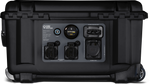 Batt Pack Energy | 3kW
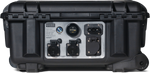 Batt Pack Pro | 5kW
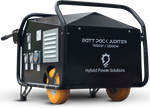 Batt Pack Jupiter | 7kW
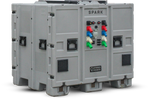 Spark Cube | 12kW/24kW
 TERRA | 166kVA
Resources

Hybrid Power Architecture Design vs Traditional Systems
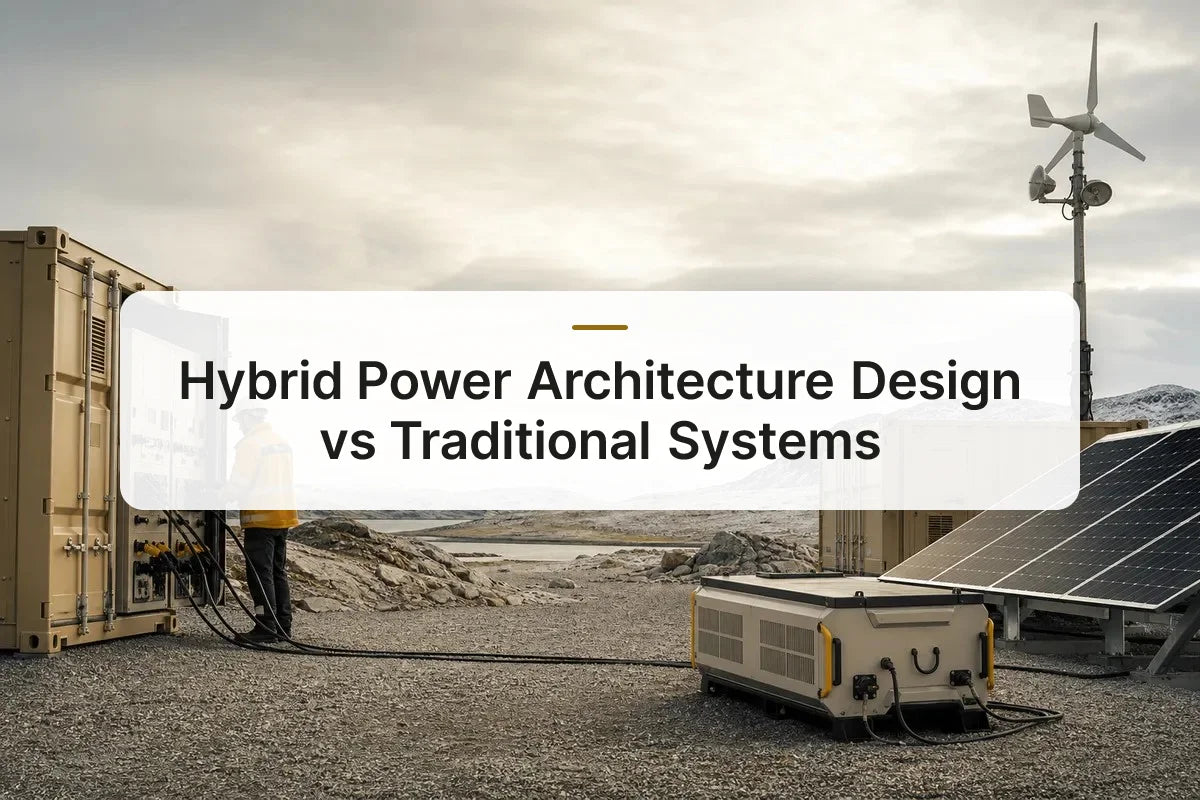
Understanding hybrid power architecture design is essential. A hybrid power architecture differs from diesel-only or grid-dependent systems by combining LiFePO4 battery storage with solar, alternator, and generator inputs under one control layer, so the generator runs only to recharge the battery instead of carrying the full continuous load. This cuts fuel burn and runtime hours, drops acoustic and thermal signature, and keeps power flowing even if one input fails. Traditional centralized systems have no battery buffer, so they must run continuously and fail hard when the single source drops out.
How Does a Hybrid Power Architecture Design Differ From Diesel-Only or Grid-Dependent Systems?
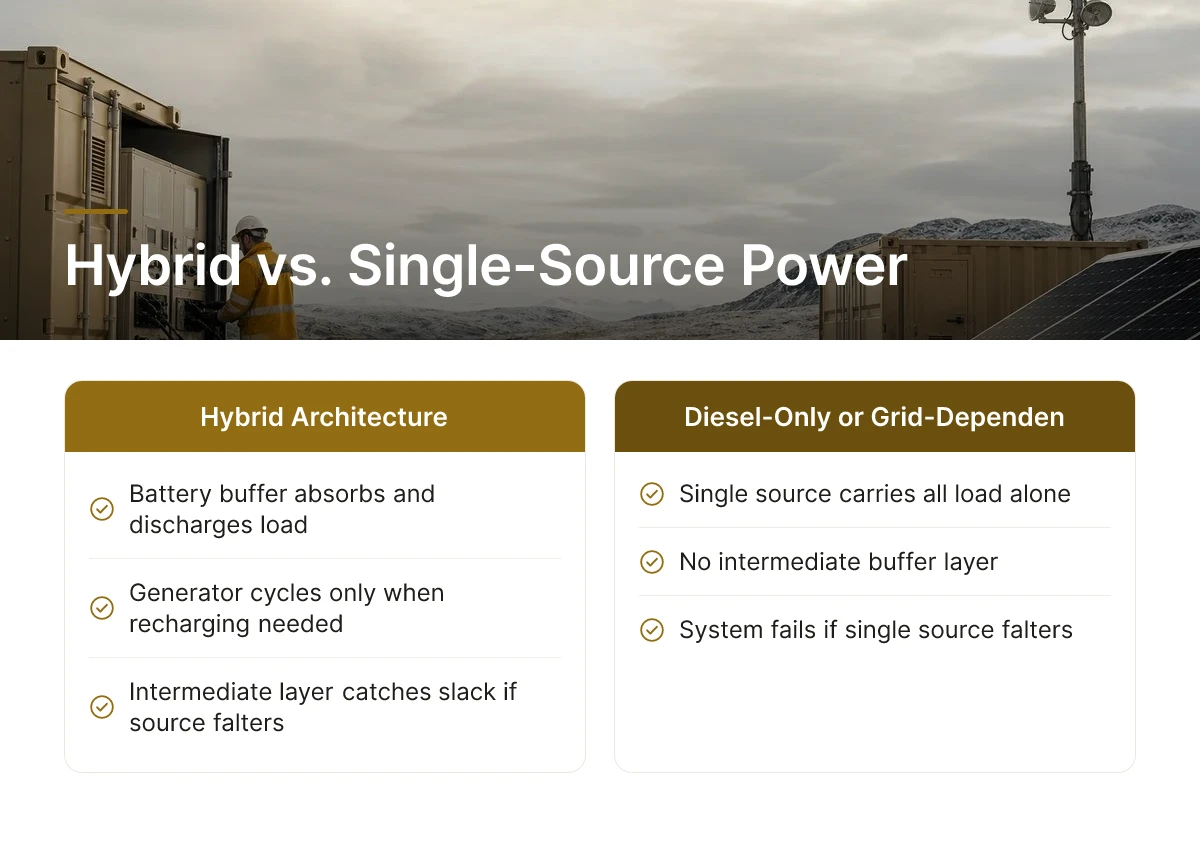
The structural difference sits in the battery buffer: a LiFePO4 pack absorbs and discharges load so the generator no longer has to carry it alone, hour after hour. This is particularly relevant for hybrid power architecture design.
A diesel-only or grid-dependent system is a single-source architecture. Every load on site traces back to one generator or one feed, and there is no intermediate layer to catch the slack if that source falters. A hybrid power architecture design inserts a battery between the source and the load. The LiFePO4 pack stores energy and releases it continuously, while the generator cycles on only when the battery needs recharging, not to carry the site around the clock. That single change, a buffer instead of a direct feed, is what separates the two architectures at a structural level, not just an operational one [1].
Failure modes diverge the same way. In a single-source setup, any fault in the generator or a break in grid supply means total loss of power, there's no second path for electricity to take. In a hybrid architecture with multiple inputs, solar, alternator, grid, generator, the control layer fails over between sources automatically. If one input drops, the battery keeps the load powered while another input picks up the recharge cycle [4].
What Are the Trade-Offs in Fuel Use, Noise, and Maintenance Between Hybrid and Traditional Power?
Fewer run-hours on the generator is the mechanism behind nearly every downstream benefit. A diesel engine that only runs to recharge a battery, rather than to carry a continuous load, burns fuel over a shorter cumulative window, which directly reduces the frequency of resupply runs. Fewer running hours also means service intervals stretch out, since wear on an engine tracks with hours run, not calendar time [1]. Less run-time compounds into a lower acoustic signature and a lower thermal signature, since the generator sits idle for longer stretches instead of radiating heat and noise continuously.
Why Do Defence and Industrial Operators Choose Hybrid Architectures Over Generator-Only Setups?
Defence and industrial buyers choose hybrid architectures because every one of those trade-offs maps to an operational risk they already manage. Lower fuel burn means fewer convoy or resupply trips into contested or remote terrain. A reduced acoustic and thermal signature matters directly to a forward operating base, where a generator's noise and heat can expose a position. And less exposed maintenance downtime, because the generator runs less and the battery carries the baseline load, keeps power available during the exact failure window when a diesel-only system would go dark. Hybridps builds this logic into its Batt Pack and TERRA hybrid microgrid lines specifically for that reason: a multi-input architecture engineered for continuous uptime, not a single centralized source operators hope doesn't fail.
What Design Principles Enable Continuous Runtime and Multi-Input Flexibility?
Continuous runtime comes from three design choices working together: a battery chemistry built for deep cycling, power electronics that blend inputs automatically, and a modular layout that scales without a redesign. Strip out any one of these and the system reverts to fixed-tank or fixed-feed thinking, the exact limitation hybrid power architecture design is meant to remove.
How Does LiFePO4 Battery Chemistry Support Reliability and Thermal Performance?
LiFePO4 (lithium iron phosphate) holds up to deep, repeated cycling and resists thermal runaway far better than generic lithium-ion chemistries used in consumer electronics. That stability matters on a forward operating base or a mining site running 24-hour shifts, where the battery is charging and discharging constantly, not sitting idle in a drawer.
Cold tolerance is the other half of the equation. A battery pack that degrades or won't accept a charge below freezing is a liability in Canadian winters or Arctic deployments, which is why Hybridps rates its systems to -30°C. That number isn't a marketing add-on, it's a direct output of cell chemistry selection combined with thermal management design: insulated enclosures, heating elements, and a battery management system (BMS) that governs charge rates as temperature changes.
What Role Do Power Electronics and Integrated Controls Play in Balancing Multiple Inputs?
Power electronics, the inverter and converter stages sitting between each energy source and the battery, do the work of turning mismatched inputs into one usable DC or AC output. Solar panels deliver variable DC depending on sunlight, an alternator delivers a different voltage profile, grid power is AC, and a generator is AC at yet another frequency and load characteristic. Without conversion and control hardware, none of these could feed the same battery bank safely. When considering hybrid power architecture design, this point stands out.
The control layer is what makes this automatic. Integrated logic reads what's available on site and routes it, so a crew doesn't have to manually switch sources when the sun sets or the generator runs low on fuel [1]. This is the principle of input-agnostic charging: the architecture accepts whatever power source is physically present, solar, alternator, grid, or generator, rather than requiring one standardized feed, which is the same logic described in hybrid battery energy storage setups where a diesel generator or solar array simply tops up the battery reservoir as available [1].
Modularity extends this logic from single units to full microgrids. A Batt Pack Energy 3kW or Batt Pack Pro 5kW uses the same input-agnostic, chemistry-driven architecture as a 167 kVA continuous TERRA hybrid microgrid, capacity scales by adding modules, not by redesigning the control system or switching chemistries.
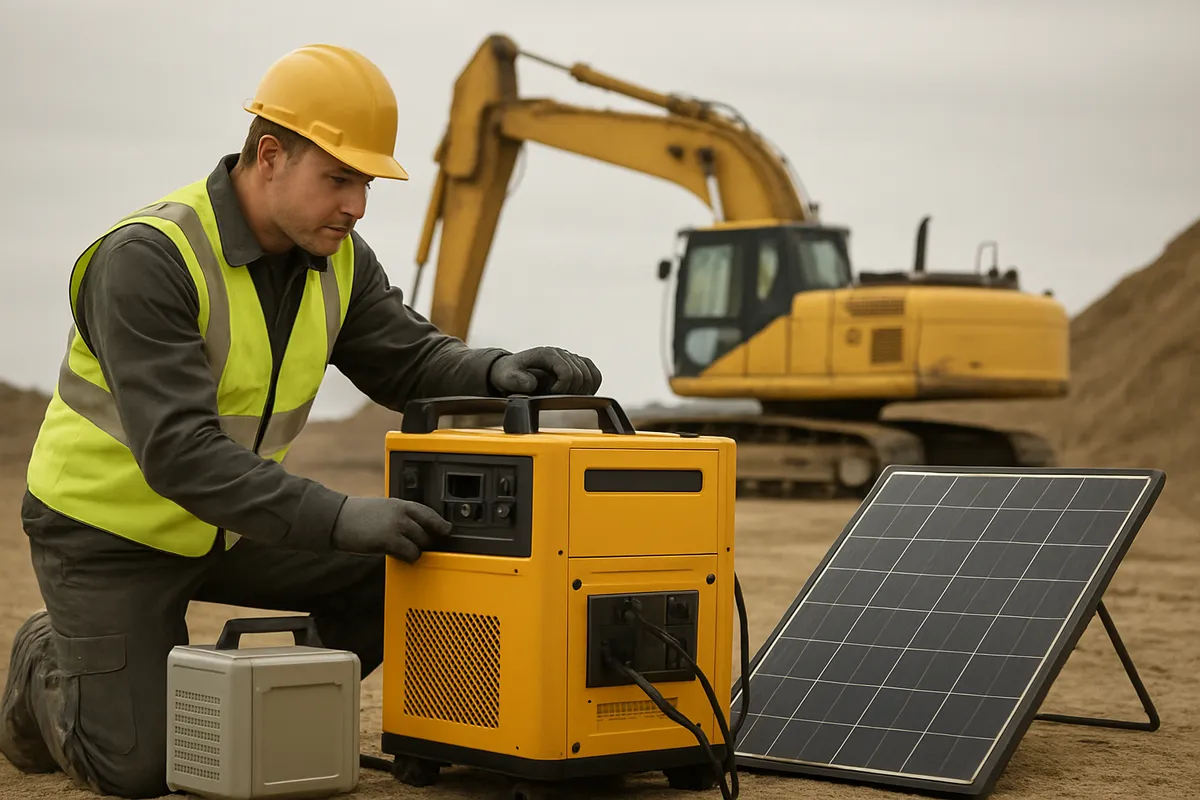
How Do Battery, Solar, Alternator, and Generator Inputs Integrate Into One System?
A control layer reads all four inputs in real time and routes whichever source is cheapest and most available to the load, with the battery bank as the constant buffer. That control logic is the real work of hybrid power architecture design, not the hardware, but the sequencing decisions made every few seconds.
How Does the Architecture Prioritize Power From Each Source to Optimize Runtime?
Solar and alternator charging get used opportunistically, whenever they're producing, because they cost nothing to run beyond the hardware already installed. The battery bank sits as the always-on buffer, discharging to the load and absorbing whatever solar or alternator current comes in behind it. The generator is treated differently: it's a deliberate top-up source, called in on a schedule or when state-of-charge drops below a set threshold, not run continuously.
This sequencing, draw from the lowest-cost input first, fall back to stored energy, and only start the generator when needed, is what separates a hybrid system from a diesel-only setup. A diesel generator sized for peak load runs at partial load most of the time, burning fuel inefficiently even when demand is low [2]. A battery buffer absorbs those swings, so the generator only runs at or near its efficient operating point, for shorter windows, when it runs at all. Fewer run-hours means less fuel hauled to site and less engine wear.
What Happens When One Input Source Fails, How Does the System Maintain Uptime?
The control layer detects a voltage or current drop from any input within milliseconds and reroutes the load to the next available source before the battery buffer notices a gap. If a cloud bank kills solar output, the system pulls harder from the battery. If the battery reaches a low state-of-charge threshold and no solar or alternator current is available, it starts the generator automatically and transfers load without the operator flipping a switch. POWR2 describes this pattern directly: a battery energy storage system acts as a dynamic reservoir, accumulating surplus power from solar or a generator and discharging it to hold the site steady when any one source drops [1].
For a forward operating base or a tactical drone recharge station, that failover has to be invisible. A dropout mid-flight-cycle or mid-mission isn't a maintenance inconvenience, it's an operational risk. This is a key reason Hybrid Power Solutions builds its Batt Pack and TERRA systems around multiple simultaneous charging inputs, solar, alternator, grid, and generator, rather than a single recharge path. For those exploring hybrid power architecture design, this matters.
| Architecture | Runtime model | Fuel dependency | Failure behaviour |
|---|---|---|---|
| Battery-only | Finite, recharge-dependent | None in use, but requires scheduled recharge or swap | Hard stop when depleted |
| Hybrid multi-input | Continuous, self-balancing | Reduced, generator runs only as needed | Automatic failover between sources |
A battery-only pack works fine for short jobs but runs down on a fixed clock, forcing a swap or a wait. A hybrid system with solar, alternator, grid, and generator inputs keeps producing indefinitely, which is the difference between a job-site convenience and a system rated for continuous drone recharging or sustained tactical power delivery.
What Control Strategies Keep a Hybrid System Reliable Under Mission-Critical Conditions?
Reliability comes from a control layer that watches every cell, every input, and every fault condition in real time, not from the battery chemistry alone. A battery management system (BMS) tracks state-of-charge, balances individual cells so none overcharges or drains faster than the rest, and shuts down or throttles output when temperature or voltage moves outside safe limits. This is the mechanism behind the uptime claims vendors make, the control logic, not just the hardware, is what prevents a fault in one cell from taking down the whole pack.
Good hybrid power architecture design treats this control layer as the product, with the battery and power electronics as the components it governs.
How Do Hybrid Systems Perform in Extreme Environments Like -30°C?
Generic lithium batteries lose usable capacity and charge acceptance sharply as temperatures drop, which is why cold-weather performance depends on chemistry and thermal design working together, not on insulation alone. LiFePO4 cells, combined with active thermal management that keeps the internal pack temperature within its working band, avoid the capacity collapse that catches operators off guard in northern Canada or at a forward operating base in winter. Hybridps engineers and assembles its Batt Pack Energy, Pro, and Jupiter units, along with the TERRA hybrid microgrid, to a -30°C operating rating, which means the control system has to manage heating, charge rate limiting, and discharge protection simultaneously rather than relying on a single fix.
What Real-World Deployment Challenges Arise When Integrating Hybrid Power?
Field friction usually shows up at commissioning, not in the spec sheet: site teams need to configure multiple charging inputs, solar, alternator, grid, generator, and operators accustomed to a single diesel unit need training on how a multi-input system sequences power sources. Integrating a hybrid unit alongside an existing generator fleet adds another layer, since the control system has to decide when to draw from stored energy versus running the generator to recharge. A well-designed architecture reduces this friction with straightforward input switching and a control interface that doesn't require a power engineer to operate day to day.
Remote monitoring and telemetry add a second layer of reliability by flagging degraded cell performance, a loose connection, or a thermal event before it causes downtime, critical for sites with no technician nearby. Ruggedization matters just as much as the electronics inside it: enclosures rated for vibration, dust, and moisture ingress keep the control system itself from becoming the point of failure in a mine, a job site, or a tactical deployment.
How Do You Select and Size a Hybrid Power Architecture for Your Operation?
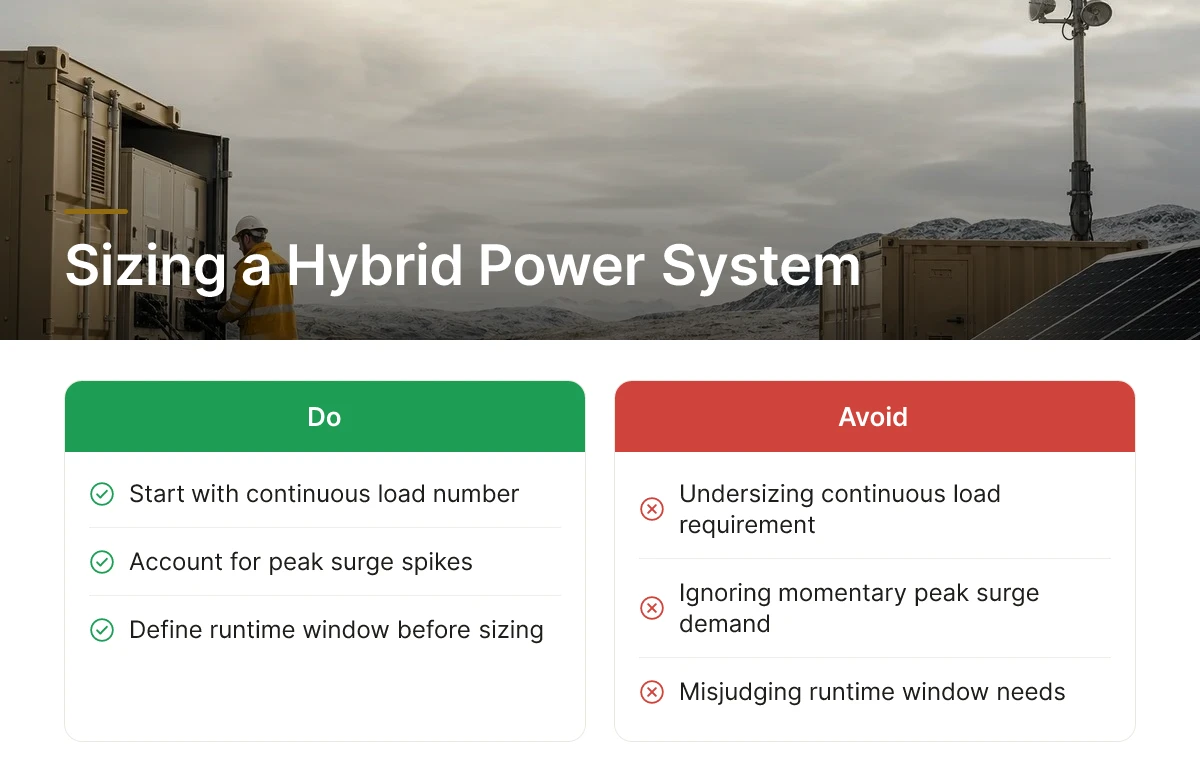
Sizing starts with three numbers: continuous load, peak surge, and runtime window, get those right before comparing specific units. This directly impacts hybrid power architecture design outcomes.
Continuous load is the steady draw your site needs hour to hour, lighting, communications, tools running in sequence. Peak surge accounts for the momentary spikes when a compressor or welder kicks on and demands several times its running wattage for a few seconds. Runtime window is how long you need to hold power between recharges, whether that's an 8-hour overnight shift on a construction site or an indefinite deployment at a forward operating base. Undersizing any one of these three creates the same failure mode a diesel generator produces: a system that trips, sags, or runs dry exactly when you need it most. Good hybrid power architecture design treats all three as fixed inputs, not afterthoughts.
What Specifications Matter Most When Comparing Hybrid Power Systems for a Mission?
The tier you need depends on whether you're powering one worker's tools or an entire site, and stacking small units rarely substitutes for moving up a class.
At the bottom of the range sit single-operator packs, Hybridps's Batt Pack Energy 3kW and Batt Pack Pro 5kW cover hand tools, lighting, and communications gear for a crew of one to a few people. Step up to the Batt Pack Jupiter 7kW or Spark Cube 12/24kW when you're running multiple trades or tools simultaneously on one pad. Beyond that, a site powering heavy equipment, multiple structures, or a forward operating base needs whole-site microgrid class, TERRA's 167 kVA continuous and 250 kVA peak rating with 162 kWh of storage. A buyer should move up a tier, rather than chain several smaller packs together, once continuous load approaches a unit's rated ceiling or peak surges start clipping, stacking adds failure points and complexity without adding headroom.
How Do Standards and Procurement Requirements Shape Hybrid Architecture Design?
Ruggedization and supply-chain control matter as much as raw output for defence and commercial procurement teams.
Units deployed in the field need to survive vibration, dust, and temperature extremes without a redesign for every climate zone, Hybridps systems are rated to -30°C and engineered for that variability from the start. Domestic manufacturing matters separately: engineering and assembly in Canada gives defence and government buyers supply-chain control and a procurement trail that imported systems can't offer.
Guidance differs by audience. Defence buyers should prioritize fuel-logistics reduction and low acoustic and thermal signature, start with the Mobile Hybrid Microgrid. Rental fleets need durable, low-maintenance units suited to a buy-or-rent model, see Buy or Rent and the Portable Power Packs line. Construction buyers typically want silent overnight power without a generator running next to a work trailer, the Batt Pack Pro and Jupiter cover that load range directly.
Frequently Asked Questions
Can a hybrid power architecture fully replace a diesel generator on a remote site?
In most cases, yes, a correctly sized battery-generator hybrid replaces a diesel-only setup entirely rather than just supplementing it. A system like TERRA, rated at 167 kVA continuous and 250 kVA peak with 162 kWh of storage, carries site loads directly while a smaller generator recharges the bank on a reduced duty cycle, cutting fuel burn and run hours. This is particularly relevant for hybrid power architecture design.
Does adding solar or alternator input complicate maintenance compared to a generator-only setup?
No, multi-input charging actually reduces maintenance because the generator runs fewer hours overall. Solar and alternator inputs are passive charging sources with no moving parts, so the main service item remains the generator and battery management system, not an additional mechanical subsystem.
How does a hybrid architecture handle drone recharging or other continuous tactical loads?
A battery bank buffers continuous draws like drone recharging so the load never depends on a generator running constantly. Units such as the Batt Pack Jupiter 7kW can dedicate output to recharge cycles while a generator or solar array tops up the reserve, keeping recharge availability constant without idling a diesel engine for hours.
What is the difference between a portable hybrid power pack and a hybrid microgrid?
A portable pack powers a single team or piece of equipment; a microgrid distributes power across an entire site. Batt Pack Energy, Pro, and Jupiter (3–7 kW) cover tools, drone recharging, and small crews, while Spark Cube (12/24kW) and TERRA (167 kVA continuous) handle multiple loads, buildings, or a forward operating base from one architecture.
Why does LiFePO4 matter more than generic lithium-ion for mission-critical power?
LiFePO4 is more thermally stable and longer-cycle-life than generic lithium-ion chemistries, which matters when failure isn't an option. That stability is also why LiFePO4 tolerates the charge cycling that comes from mixing solar, alternator, grid, and generator inputs in one system without accelerated degradation.

Conclusion
Designing power around a battery core rather than a generator changes what a site can do: continuous runtime instead of fuel-dependent uptime, multiple charging inputs instead of one point of failure, and a low acoustic and thermal signature instead of a running diesel engine announcing your position. The architecture scales from a single Batt Pack Pro on a job site to a TERRA microgrid running a forward operating base. Start by mapping your site's actual load profile, continuous draws, peak demand, available charging inputs, against the Batt Pack, Spark Cube, and TERRA tiers to see where your current diesel setup is over- or under-built.
Sources & References
- Hybrid Power Systems 101 | BESS | POWR2
- Hybrid Solar And Diesel Generator Power Systems Explained
- What Are the Challenges of Deploying a Hybrid Power Architecture?
Recommended Articles
Explore more from our content library: