

Produits
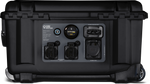 Pack de batteries énergétiques | 3kW
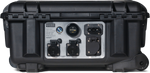 Bloc-batterie Pro | 5 kW
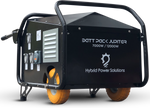 Batterie Jupiter | 7kW
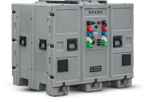 Spark Cube | 12kW/24kW
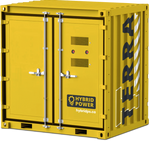 TERRA | 166kVA
Ressources

Finding Top-Rated Industrial Generator Suppliers
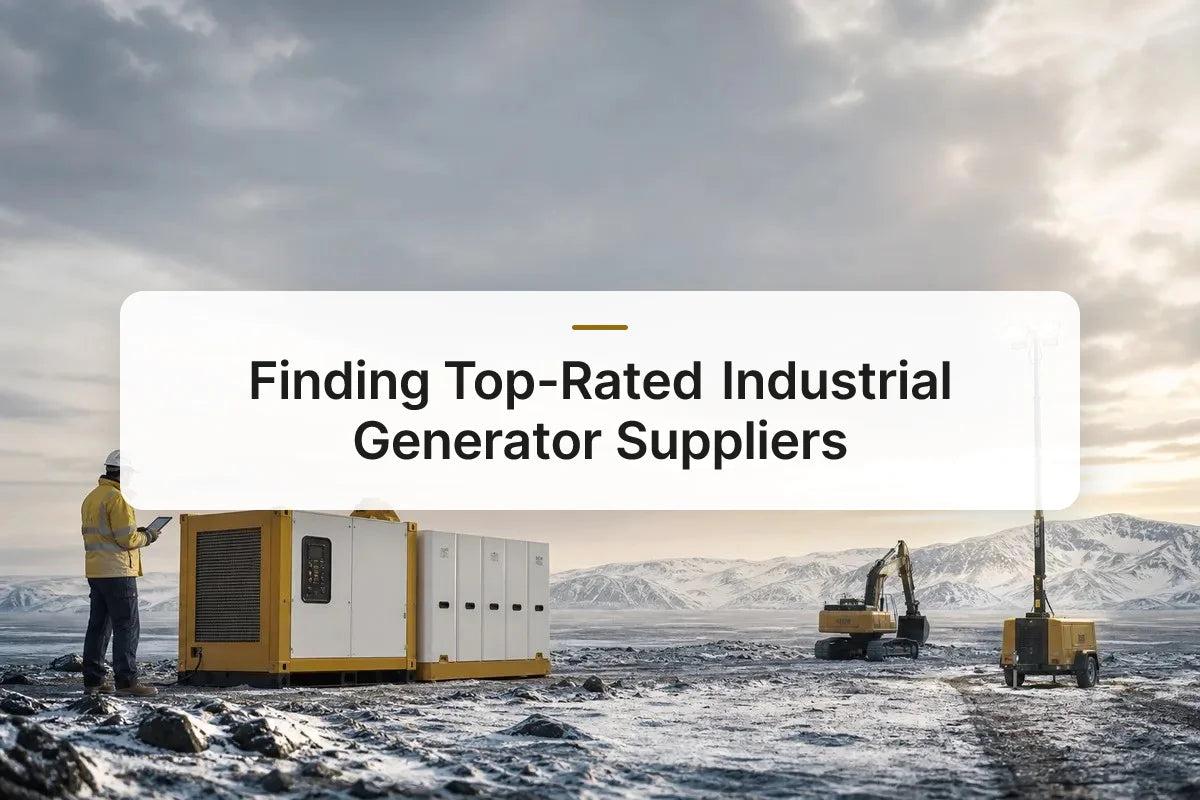
Top-rated industrial generator suppliers today are increasingly hybrid and battery-based power system manufacturers that replace or supplement diesel generators with LiFePO4 battery packs, multi-input hybrid architecture, and silent continuous-runtime microgrids. For defence, rental, and construction buyers, the best supplier is judged on power tier range, cold-weather rating, fuel-logistics reduction, and hybrid integration with solar, alternator, grid, and generator inputs, not just diesel engine specs. Evaluating suppliers means matching power class (3kW portable packs through 167 kVA hybrid microgrids) to mission requirements, not picking a single fixed generator model.
What You'll Need Before Evaluating Industrial Generator Suppliers
Before comparing industrial generator suppliers, gather three inputs: your site's load profile, your deployment environment, and your mission duration. Without these numbers, supplier comparisons turn into spec-sheet shopping instead of matching a system to the job.
Build your evaluation inputs
- Load profile, Separate continuous kW draw from peak kW demand. A forward operating base charging drones and running comms draws differently than a jobsite running saws and lighting towers on and off.
- Deployment environment, Document temperature extremes, remoteness (fuel resupply frequency and distance), and any acoustic or thermal signature limits. A cold-weather site in northern Canada has different failure risks than a coastal jobsite under municipal noise bylaws.
- Mission duration, Define whether power needs to run for a 12-hour shift, a multi-week deployment, or indefinitely. Duration determines whether a battery pack alone covers the job or whether you need a hybrid input to sustain it.
These three inputs matter because defence, rental, and construction buyers weigh supplier criteria in different orders. A defence procurement team prioritizes fuel-convoy risk and low acoustic and thermal signature near a forward operating base, every diesel resupply run is a logistics liability and a detection risk. A rental fleet operator prioritizes durability across repeat deployments and minimal maintenance downtime between contracts. A construction site manager prioritizes overnight noise compliance and simple setup on a schedule that changes weekly. The same generator spec sheet can satisfy one buyer and fail another.
Use LiFePO4 (lithium iron phosphate) as your baseline chemistry when evaluating battery-based options. It runs a safer thermal profile and holds a longer cycle life than generic lithium-ion or lead-acid alternatives [3], which matters directly for extreme-heat jobsites and cold-weather defence deployments where thermal runaway risk and battery degradation both carry real operational cost.
Finally, know what you're actually buying. A diesel generator is a single fixed-output purchase. A hybrid system, accepting solar, alternator, grid, and generator inputs, is a configuration exercise, not a one-line selection [4]. That distinction changes how you scope the rest of this evaluation.
Identify What Sets Hybrid Industrial Generator Suppliers Apart from Diesel-Only Vendors
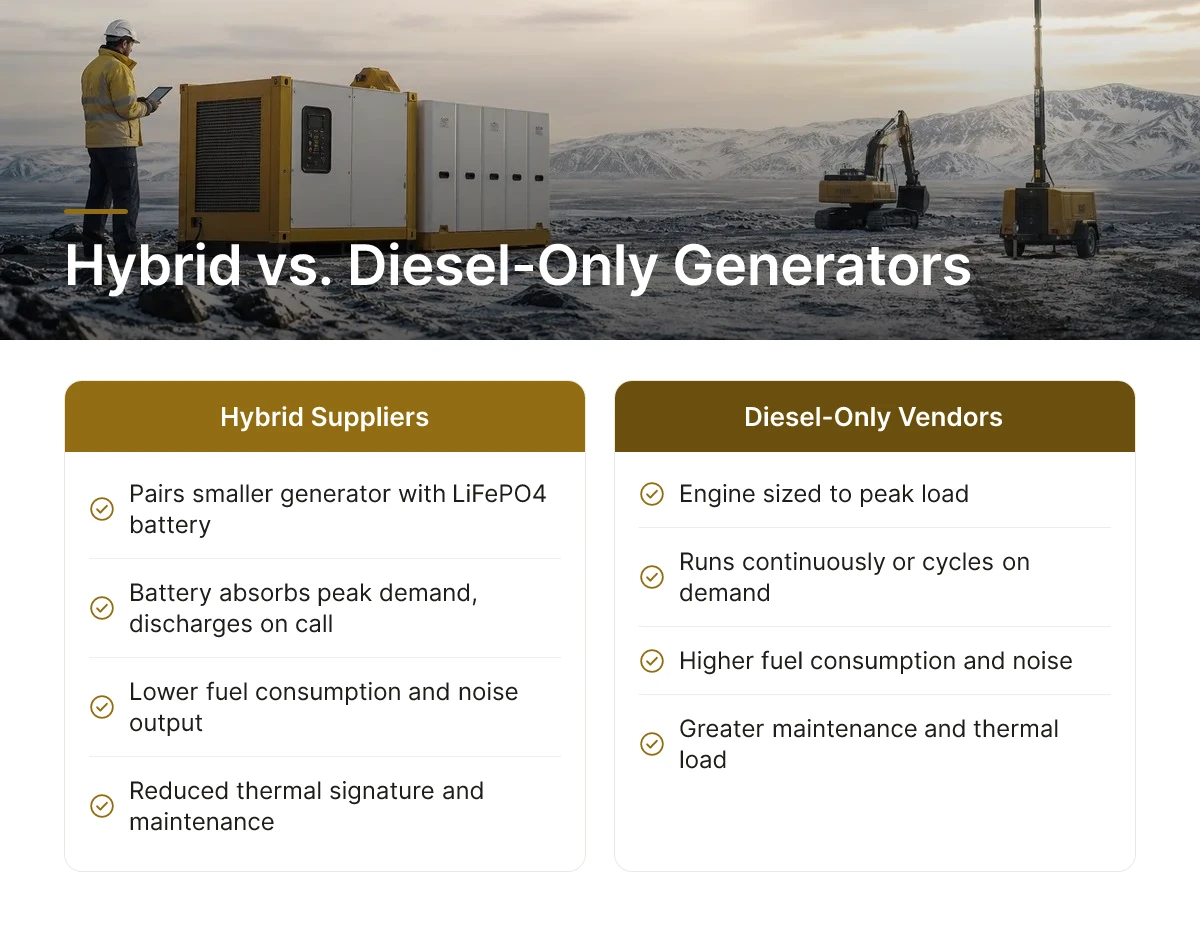
Hybrid industrial generator suppliers differ from diesel-only vendors at the mechanism level: battery buffering, multi-input charging, and instant power delivery replace continuous fuel combustion as the core design principle.
A diesel-only vendor sells an engine sized to peak load, running continuously or cycling on load demand. A hybrid supplier instead pairs a smaller generator (or none at all) with a LiFePO4 battery bank that absorbs peak demand and discharges on call. That architectural shift changes fuel consumption, noise output, thermal signature, and maintenance load, the evaluation criteria that matter for the rest of this guide.
How Fuel Logistics, Noise, and Emissions Benefits Play Out in Defence and Remote Operations
Fuel-logistics reduction works because the battery, not the generator, carries transient and peak loads, which lowers total fuel burn and lets the generator run fewer hours at a steadier, more efficient load point. A diesel unit running at 25% load burns significantly more fuel per kilowatt-hour than the same unit at 75% load [1], so a battery that smooths demand keeps the generator closer to its efficient band. Fewer running hours means fewer resupply convoys, less on-site fuel storage, and reduced handling risk, a direct win for forward operating bases where every fuel convoy is a logistics and security liability. Acoustic and thermal signature matter differently for defence than for a construction site. A quieter generator is a courtesy on a jobsite; a low acoustic and thermal signature at a forward operating base or a drone recharging station is a detection risk reduction. Battery-based power draws no heat plume from combustion and produces no engine noise during discharge, which matters for units operating near populated areas or under surveillance risk. Diesel-only vendors have no mechanism to address this, the engine has to run to produce power, and running produces both heat and sound.
How LiFePO4 and Multi-Input Architecture Improve Mission-Critical Reliability
LiFePO4 battery systems deliver power instantly, with no warm-up cycle, while diesel generators need startup time and often idle at partial load, wasting fuel before they reach useful output. That startup lag matters when drone recharge windows or critical loads can't wait 30 to 60 seconds for an engine to stabilize. Instant-on power also avoids the idle-burn waste that accumulates over a multi-week deployment. Multi-input hybrid architecture is the second mechanism worth naming. Systems that accept solar, alternator, grid, and generator inputs, the configuration Hybrid Power Solutions builds into its Batt Pack and TERRA platforms, remove the single-point dependency on diesel resupply that defines conventional generator ownership. If fuel delivery is delayed, solar or alternator charging keeps the battery topped up. A hybrid battery energy storage system paired with a generator or renewables improves overall system efficiency and reliability compared with a generator running alone [3]. Regulatory pressure reinforces the shift. Noise ordinances near populated areas and emissions rules on job sites increasingly narrow the field of acceptable industrial generator suppliers, pushing procurement teams toward hybrid and battery-buffered options by default rather than exception.
Match Power Tiers and Runtime to Your Mission or Site Requirements
Sizing a hybrid power system starts with matching load and mission duration to a power class, then checking that class against your climate and deployment method. Industrial generator suppliers that only sell one power tier will push you toward the wrong fit; the right supplier walks you through at least three tiers before recommending anything.
What Power Tiers and Runtime Capabilities to Expect Across Supplier Product Lines
Three power classes cover most industrial, defence, and rental scenarios, and each maps to a distinct job.
- Portable battery packs (3-7kW class): Sized for tool power, single-operator field kits, and drone recharging at a forward position. Hybridps builds this tier as the Batt Pack Energy (3kW), Batt Pack Pro (5kW), and Batt Pack Jupiter (7kW), enough to run hand tools, lighting, and charging stations without a generator running nearby.
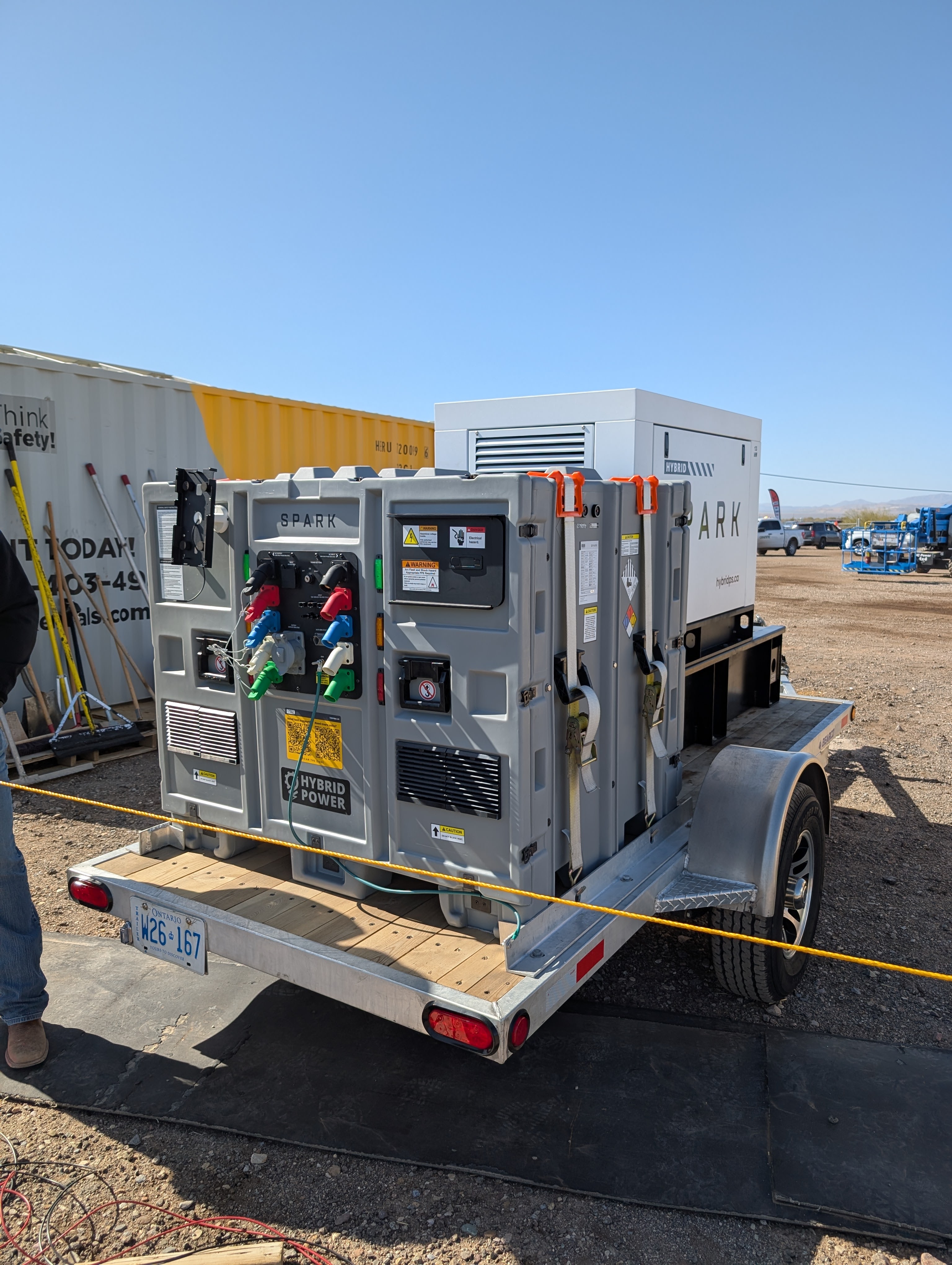
- Mid-tier hybrid cubes (12/24kW): Built for jobsite trailers, shelters, or small forward operating positions running multiple circuits at once. The Spark Cube 12/24kW sits here, bridging single-operator packs and full microgrids.
- Hybrid microgrids (167 kVA continuous / 250 kVA peak): Designed for whole-site or forward operating base power, where a single system replaces several diesel units. The TERRA platform delivers 162 kWh of storage alongside that continuous rating, built for sites that cannot tolerate an outage.
Undersizing is the most common mistake, a 5kW pack asked to run 12kW of intermittent load will cycle constantly and shorten battery life. Oversizing wastes capital. Reliable industrial generator suppliers ask for a load schedule, not just a peak wattage number, before recommending a tier.
How Hybrid Systems Integrate Solar, Alternator, Grid, and Generator Inputs for Continuous Operation
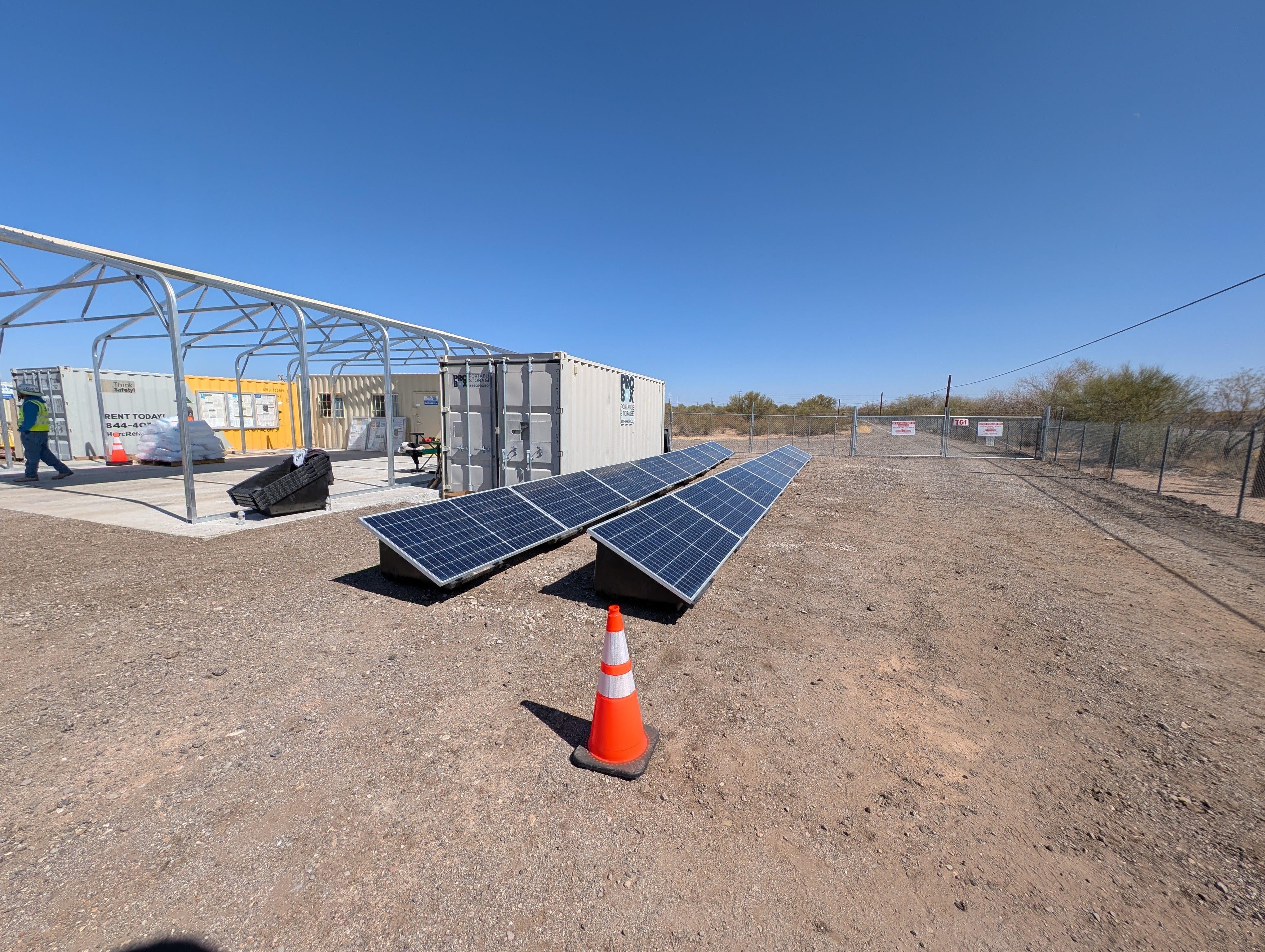
Runtime depends on the charging inputs feeding the battery, not the battery capacity alone. A battery-only pack is recharge-dependent, once the stored energy is gone, the site waits for a swap or a plug-in. Hybrid systems that accept solar, alternator, grid, and generator inputs recharge continuously in the background, which is what turns a fixed charge cycle into indefinite runtime for long deployments [3]. A mobile hybrid battery energy storage configuration paired with a generator or renewables commonly improves system efficiency and reliability over running a generator alone [3], and research on hybrid supply architectures for mission-critical, off-grid loads backs the same logic: blending storage with a fuel or renewable input consistently outperforms a single-source setup on efficiency and cost over time [2]. Cold weather changes the sizing math again. Battery chemistry and thermal management both degrade in sub-zero conditions, so a system rated only for temperate climates will underperform or fail outright on an Arctic or northern Canadian winter deployment. A -30°C rating, engineered and tested rather than assumed, is the deciding factor for construction crews working through a Canadian winter or defence units staging in the North.
Deployment method is the last variable. Trailer-mount configurations and spider box distribution let a crew move a mid-tier or microgrid system to a new position in hours rather than days, critical for emergency response and mobile defence units that cannot wait on a fixed installation. Match the tier, the input mix, the temperature rating, and the deployment format together, and the sizing decision becomes straightforward rather than guesswork.
Compare Total Cost of Ownership and Buy-or-Rent Options Across Suppliers
Total cost of ownership shifts diesel spending into fuel and maintenance over time, while hybrid systems concentrate cost upfront and cut ongoing overhead, the right choice among industrial generator suppliers depends on project length, site regulation, and fleet strategy.
What Maintenance, Fuel, and Compliance Cost Differences Look Like Over a Project Lifecycle
Diesel-only power accumulates cost through three channels: fuel burn, scheduled service intervals, and downtime while units are serviced. A diesel generator running at partial load burns fuel less efficiently than one running near capacity, and that inefficiency compounds daily on remote sites where fuel delivery itself carries a cost premium [1]. Maintenance follows a similar pattern, oil changes, filter swaps, and engine wear parts are recurring line items, and each service event typically takes the unit offline.
Hybrid systems invert that structure. The upfront investment is higher, but LiFePO4 battery platforms with multiple charging inputs, solar, alternator, grid, or generator, reduce fuel consumption and stretch maintenance intervals substantially [3]. Combining a battery energy storage system with a generator lets the generator run closer to its efficient load band, or not run at all during quieter draw periods, which lowers both fuel spend and engine wear over the deployment [4].
Compliance costs add another variable that's easy to underweight during procurement. Noise ordinances near residential zones, emissions permitting for extended diesel runtime, and jobsite-specific environmental conditions all vary by municipality and industry. A hybrid system's silent, lower-signature operation avoids permitting delays and potential fines that diesel-only fleets face in regulated zones, a factor that tilts lifecycle cost further toward hybrid on any site where compliance risk is real, not hypothetical.
What Financing, Lease-to-Own, and Rental Options Are Available for Construction and Industrial Projects
Buy-versus-rent comes down to three variables: project duration, fleet utilization rate, and how much capital a business wants tied up in equipment. Short, single-site projects generally favor renting, there's no benefit to owning a unit that sits idle after a three-month job wraps. Long-term or repeat deployments, like a mining site running for several years or a rental fleet operator servicing recurring contracts, favor buying, since the equipment pays down its upfront cost across many billable cycles.
Rental fleet operators face a distinct calculation: they need durable, low-maintenance units that hold up across renters with varying skill levels and site conditions. This is where buy-or-rent program structures matter, a supplier offering both purchase and rental paths lets a construction firm test a platform on one job before committing capital to a fleet.
When comparing industrial generator suppliers on procurement terms, evaluate:
- Warranty length and what components it covers
- Service level agreements, response time commitments for field support
- Maintenance plan structure, scheduled versus on-demand servicing
- Parts and technical support availability, especially for remote or northern sites
For defence and government buyers, procurement risk extends beyond the spec sheet. Canadian-made manufacturing with domestic supply-chain control reduces exposure to cross-border delays, and working with a publicly traded, audited supplier adds a transparency layer that matters when contracts require vendor accountability.
Common Mistakes to Avoid When Selecting an Industrial Generator Supplier
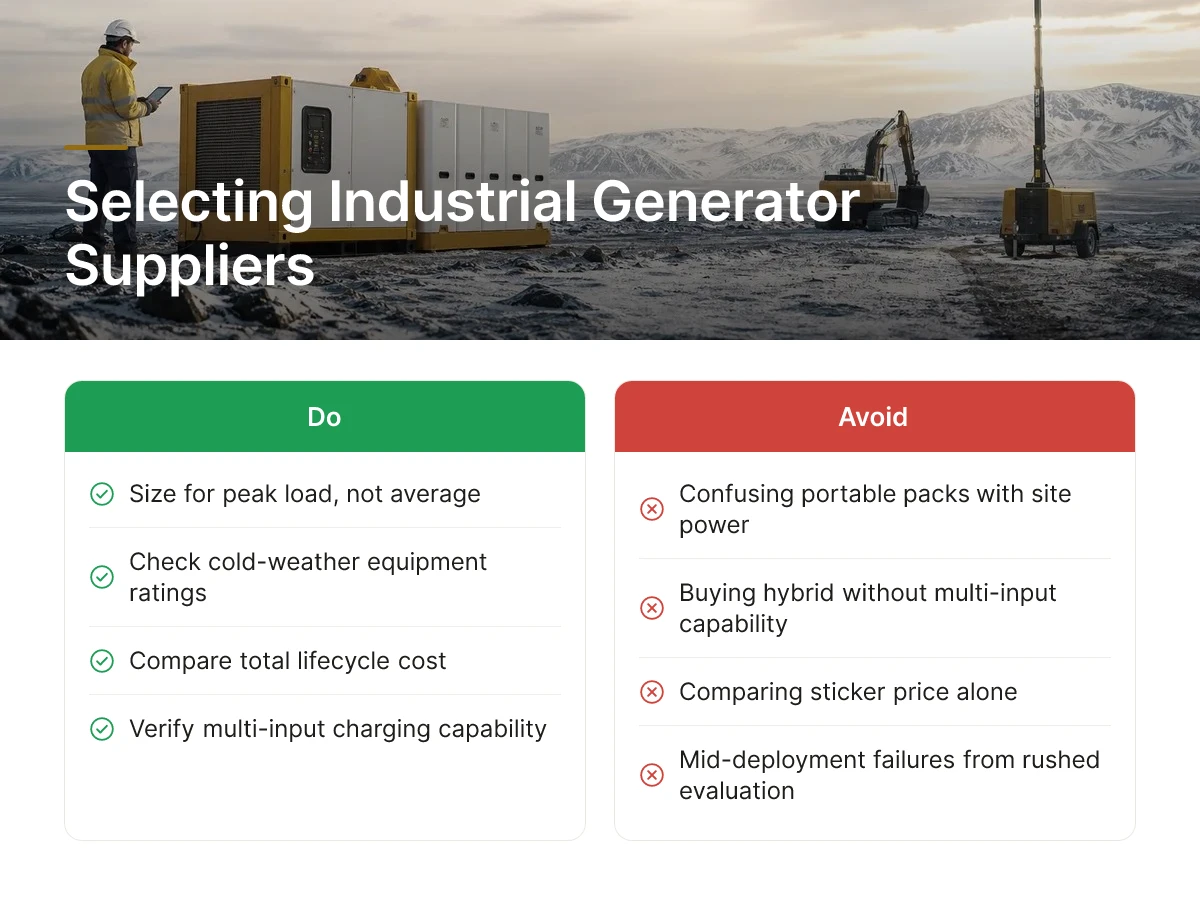
Most procurement failures trace back to five recurring errors: sizing for average load, confusing portable packs with site-wide power, ignoring cold-weather ratings, buying "hybrid" without multi-input capability, and comparing sticker price instead of lifecycle cost.
Each mistake is avoidable, but each one shows up repeatedly when teams evaluate industrial generator suppliers under contract deadlines. Slowing down at the evaluation stage costs less than a mid-deployment failure.
- Sizing for average load, not peak load. A site's average draw might sit well below capacity, but startup surges from compressors, pumps, or drone charging stations can spike well past that baseline. Undersizing here means brownouts or trips exactly when the load is heaviest, the worst possible time on a mission-critical site.
- Treating a portable pack as a microgrid substitute. Lightweight, single-operator battery packs solve tool-scale power problems well. They were not built to run an entire remote site, a forward operating base, or a multi-crew construction yard. Buyers who scale a briefcase-class unit up mentally, without checking continuous kVA and kWh ratings, end up short on capacity mid-project.
- Overlooking cold-weather ratings. Diesel units face fuel gelling and cold-start failure in northern winters, and not every battery system holds performance below freezing. Confirm the actual operating temperature rating, not just a marketing claim, before deploying to Arctic or northern job sites.
- Ignoring multi-input compatibility. A "hybrid" system that only recharges from one source is a battery pack with a label. Real hybrid architecture accepts solar, alternator, grid, and generator inputs, so a site keeps running when one charging path is unavailable [3][4].
- Comparing sticker cost alone. Purchase price ignores fuel logistics, maintenance intervals, and warranty terms, the factors that determine total cost over a decade of operation [1]. A cheaper unit with frequent servicing and constant diesel resupply often costs more over its service life than a higher-upfront hybrid system with fewer moving parts.
How to Verify a Supplier Can Meet Defence, Industrial, and Construction Requirements at Scale
- Request continuous and peak power specifications in writing, not marketing copy, for the exact configuration you plan to deploy.
- Ask for documented operating temperature ranges, especially if any site sits north of the 55th parallel or runs winter shifts.
- Confirm which charging inputs the system accepts and whether solar, alternator, and generator charging can run concurrently, not just sequentially.
- Check manufacturing origin and supply chain control, domestic assembly matters for defence and government procurement timelines.
- Compare warranty terms and service intervals across suppliers, not just unit price, before scaling a fleet purchase.
Hybridps addresses these gaps directly: the Batt Pack line covers tool-scale needs, while Spark Cube and the TERRA hybrid microgrid, rated to 167 kVA continuous, 250 kVA peak, and 162 kWh, extend into whole-site power that portable packs were never designed to handle. Every system is engineered and assembled in Canada, rated to -30°C, and built around solar, alternator, grid, and generator inputs so a single failed charging path never means a stalled site.
Frequently Asked Questions
Can hybrid battery power systems fully replace diesel generators on industrial sites?
Yes, for many sites, but the right configuration depends on load size and duty cycle. A Batt Pack Pro 5kW or Jupiter 7kW can carry tool and lighting loads outright, while a Spark Cube 12/24kW or TERRA microgrid (167 kVA continuous) handles whole-site power, often with a generator retained only as backup charging input rather than the primary source.
What is the difference between a battery-only power pack and a hybrid generator system?
A battery-only pack runs until depleted then needs recharging; a hybrid system accepts multiple charging inputs to sustain continuous runtime. Hybridps units take solar, alternator, grid, or generator input, so a site isn't locked into a recharge-and-swap cycle the way a single-source battery pack is.
Do hybrid power systems work reliably in extreme cold or Arctic conditions?
Reliability depends entirely on the battery chemistry and thermal management, not just the "hybrid" label. LiFePO4 systems rated for -30°C, like Hybridps's Batt Pack and TERRA lines, avoid the cold-start failures and fuel gelling that plague diesel units in northern winters. Not every battery-based supplier publishes a cold-weather rating, so confirm it before deployment [1].
How do fuel-logistics savings from hybrid systems matter for defence deployments specifically?
Fewer fuel convoys mean less exposure and lower operational risk at forward operating bases. Reducing resupply trips also lowers the site's acoustic and thermal signature, which matters as much as cost savings in tactical environments [2]. A hybrid system that recharges from solar or a generator at longer intervals cuts both convoy frequency and detectability.
Is it better to buy or rent hybrid power equipment for a short-term construction project?
Renting suits short, defined jobs; buying pays off when deployments recur across multiple sites or seasons. Rental fleets benefit from durable, low-maintenance units that survive repeated redeployment, which is why Hybridps offers both a Buy or Rent program and direct purchase for construction and rental operators.
Conclusion
Choosing among industrial generator suppliers now means comparing fuel logistics, acoustic signature, and cold-weather reliability, not just fuel tank size and kVA rating. The sites that gain the most are the ones running remote, noise-restricted, or cold-climate operations where diesel resupply and maintenance eat into margins fastest.
Start by auditing one site's actual load profile and fuel-delivery cost over the last year, then match it against a hybrid configuration, Batt Pack Pro for tool loads, Spark Cube or TERRA for whole-site power. Request a demo at hybridps.ca to size a system against your real numbers before your next contract mobilizes.
Sources & References
- Hybrid Generator vs. Diesel Generator Comparison - Cost, Efficiency & Performance
- Frontiers | Fuel efficiency and economic assessment of a hybrid power supply system for mission critical applications
- Mobile Hybrid BESS vs Diesel Generators Comparison
- Hybrid Power Systems 101 | BESS | POWR2
Recommended Articles
Explore more from our content library: