

Products
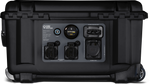 Batt Pack Energy | 3kW
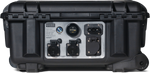 Batt Pack Pro | 5kW
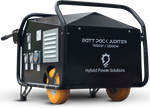 Batt Pack Jupiter | 7kW
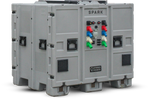 Spark Cube | 12kW/24kW
 TERRA | 166kVA
Resources

A Practical Guide to Choosing the Right On Site Power System
On site power means generating or storing electricity at the job site itself rather than drawing solely from the grid or a standalone diesel generator. For industrial, defence, rental, and construction operations, this increasingly means hybrid systems that pair LiFePO4 battery storage with solar, generator, or grid inputs, cutting fuel logistics, lowering noise and thermal signature, and keeping critical loads running when diesel-only or grid-only options fail. The right mix depends on site duration, load size, and how much runtime independence the mission requires.
What Counts as On Site Power, and How Does It Differ From Grid or Diesel-Only Setups?
Three setups define how a site gets power: grid-only, diesel-only, and hybrid battery-based on site power that draws from multiple sources at once.
- Grid-only: no answer when the utility goes down, a storm, a substation fault, or scheduled maintenance leaves critical loads exposed with no local backup.
- Diesel-only: trades that risk for fuel dependency, run-hour maintenance cycles, and noise or emissions limits that increasingly draw regulatory attention on job sites and bases alike.
- Hybrid, battery-based: sits between the two, storing energy on site and accepting charge from more than one source so a single point of failure doesn't take down the load.
Why Sites Are Moving From Diesel-Only to Hybrid Battery and Solar Combinations
Remote and industrial operators are shifting away from diesel-only setups because fuel delivery is a logistics problem, not just a cost line. A generator that's dependent on scheduled fuel runs is only as reliable as the convoy or supply route behind it, a liability on forward operating bases, winter job sites, and disaster-relief deployments where resupply can be delayed or cut off entirely. Diesel generators also accumulate run-hours that drive maintenance intervals, and many sites now face noise restrictions that a combustion engine simply can't meet overnight or near residential boundaries.
Distributed, on-site generation is gaining ground industry-wide as utilities struggle to keep pace with rising power demand and aging infrastructure [1]. For remote and defence sites that were never grid-connected in the first place, the comparable shift is from diesel-only to hybrid battery and solar combinations that cut fuel burn without sacrificing runtime. The US EPA's guidance on on-site renewable energy generation outlines similar drivers behind the broader move toward distributed, site-based power.
What Multi-Input Power Architecture Means for Mission-Critical Operations
Multi-input architecture means one battery bank that accepts charge from solar panels, a vehicle alternator, grid power, or a generator, whichever is available on site. Hybridps builds its Batt Pack and Spark Cube systems around this principle: the site isn't locked into one fuel type or one connection, so charging continues even if solar output drops overnight or grid access is unreliable. Chemistry matters here. LiFePO4 (lithium iron phosphate) offers longer cycle life and better thermal stability than generic lithium-ion, which is why it's the chemistry behind most hybrid on site power platforms built for repeated deep discharge and extreme temperature swings, including Hybridps systems rated to -30°C.
For a closer look at how these inputs combine into a working system, see our hybrid power architecture explainer, or our off-grid power solutions page for deployment specifics. For a broader overview of how on-site generation works in practice, this explainer on on-site power generation covers the underlying concepts in more depth.
How Do Hybrid Battery Systems Compare to Traditional Generators On Site?
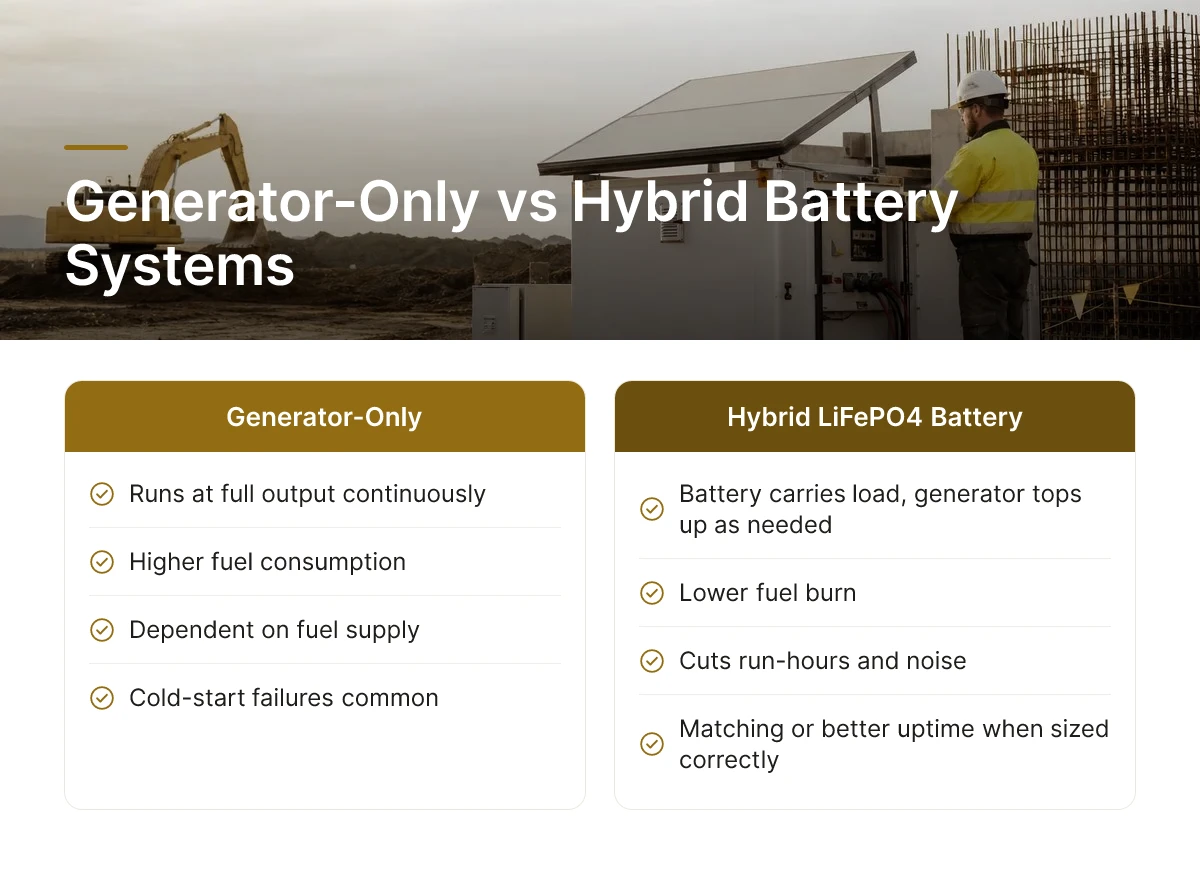
Hybrid LiFePO4 battery systems cut run-hours, noise, and thermal signature versus generator-only setups, while matching or beating uptime once sized correctly for the load.
A generator carrying a continuous load runs whether the site needs full output or not. A hybrid system flips that logic: the battery carries the load, and the generator (or solar, or grid, or alternator) tops up the battery only when needed. That single change drives most of the differences below.
| Factor | Generator-Only | Hybrid LiFePO4 Battery System |
|---|---|---|
| Reliability / uptime | Dependent on fuel supply and mechanical uptime; cold-start failures common | Battery carries load continuously; charging input is flexible (solar, alternator, grid, generator) |
| Noise level | Continuous operating noise for full run duration | Near-silent battery operation; generator (if present) cycles intermittently |
| Thermal signature | Sustained heat output for entire run cycle | Low thermal signature during battery-only operation |
| Maintenance burden | Run-hour-based servicing: oil changes, filters, moving parts wear | Minimal moving parts; service intervals tied to charge cycles, not continuous runtime |
| Refuelling dependency | Constant fuel logistics, storage, and convoy/delivery risk | Reduced fuel burn; recharge via solar, grid, or short generator cycles |
What Performance Advantages Do LiFePO4 Battery Systems Offer Over Generator-Only Power?
LiFePO4 chemistry tolerates repeated deep discharge cycles far better than the stress a generator-only setup places on mechanical components forced to run continuously under load.
A diesel unit sized to carry a site's peak demand often runs at partial load for long stretches, which increases wear and fuel inefficiency. A battery bank, by contrast, draws down and recharges without the mechanical fatigue of pistons, bearings, and fuel injectors cycling for hours on end. Cold-weather performance is where the gap widens further, generators face fuel gelling and cold-start failures, while Hybridps systems are rated for continuous operation down to -30°C, a spec that matters directly for northern construction, mining, and defence deployments.
How Do Noise, Emissions, and Thermal Signature Affect Site Compliance?
Lower acoustic and thermal signature helps sites clear noise ordinances, night-work permits, and defence detection thresholds that generator-only power often can't meet.
Municipal noise bylaws and night-work permits frequently cap decibel output near occupied areas, and a generator running continuously through a night shift is a common source of violations and complaint-driven shutdowns. Near-silent battery operation removes that risk for construction and rental sites working extended hours. For defence applications, acoustic and thermal signature also factor into detectability at a forward operating base, a quieter, cooler power source is a tactical advantage, not just a regulatory one [2].
This is also where hybrid design pays off operationally: instead of a generator carrying the full load around the clock, it charges the battery intermittently, cutting generator run-hours, fuel burn, and mechanical wear in one move. On site power needs vary by hour and by shift, and a hybrid system matches output to that variability rather than running flat-out regardless of demand [1].
Scale matters too. A single portable pack handles tool-level loads, but construction sites, remote mines, and forward operating bases often need more. Hybridps's lineup runs from the Batt Pack Energy 3kW and Pro 5kW through the Jupiter 7kW, up to the Spark Cube 12/24kW and the TERRA hybrid microgrid at 167 kVA continuous, a power class built for whole-site deployment, not just a single operator's tools.
What Do Hybrid On Site Power Systems Actually Cost to Run Over Time?
Hybrid on site power systems typically cost less over a multi-year deployment than diesel-only setups because they cut fuel burn, stretch maintenance intervals, and reduce downtime risk.
The purchase price of a generator or battery system is only the entry point. The real cost shows up over months and years of run-hours, refuelling trips, and service calls, and that's where diesel-only fleets lose ground.
What Does Total Lifecycle Cost Include Beyond the Purchase Price?
Four cost components drive total lifecycle spend on remote or job-site power:
- Fuel consumption: the most visible line item. A diesel generator carrying continuous load burns fuel constantly, and every litre has to be sourced, trucked, and stored, a logistics chain that gets more expensive and more fragile the farther the site sits from a depot.
- Scheduled maintenance: follows run-hours, oil changes, filter swaps, and injector servicing scale directly with how many hours the engine actually runs, not with how many hours of power the site needed.
- Downtime risk: harder to see on a budget line but often costs more than fuel or maintenance combined. A generator failure on a remote mine site or forward operating base doesn't just stop power, it stops the work that depends on it.
- Emissions and noise compliance: regulated sites face fines, permitting delays, or operating restrictions tied to decibel limits and exhaust output, costs that diesel-only operators carry indefinitely and hybrid operators largely avoid.
How Do Fuel Logistics and Deployment Speed Affect Project Economics?
A hybrid setup, battery storage paired with solar, grid, alternator, or generator charging, cuts generator run-hours by covering baseline and peak loads from the battery pack instead of making the engine run continuously. Fewer run-hours means less fuel burned, longer intervals between service visits, and a smaller window in which a mechanical failure can strand a crew.
Deployment speed is the other half of the economics. A trailer-mounted or pre-wired hybrid unit can be towed in and connected in a fraction of the time it takes to permit, site, and hard-wire a stationary diesel generator. For rental fleets cycling equipment between sites, that speed compounds, less idle time between contracts, faster turnaround, lower labour cost per deployment. Hybridps's Buy or Rent program is built around that cycle, letting rental operators size a unit to a contract without committing capital to a system that outlives the job.
System sizing drives where a project lands on the cost tier. A budget-friendly entry point like the Batt Pack Energy 3kW suits smaller tool and lighting loads, mid-range tiers such as the Batt Pack Pro 5kW or Jupiter 7kW cover most construction job-site needs, and premium configurations, Spark Cube 12/24kW or the TERRA hybrid microgrid, scale toward whole-site or forward operating base power. Construction teams sizing a job site should start with the Batt Pack Pro or Jupiter lineup before stepping up to microgrid-class capacity. Industry power generation solutions overviews offer useful context on how system sizing decisions scale from single-site to multi-site deployments.
Which On Site Power Technology Fits Defence, Rental, Construction, and Emergency Response?
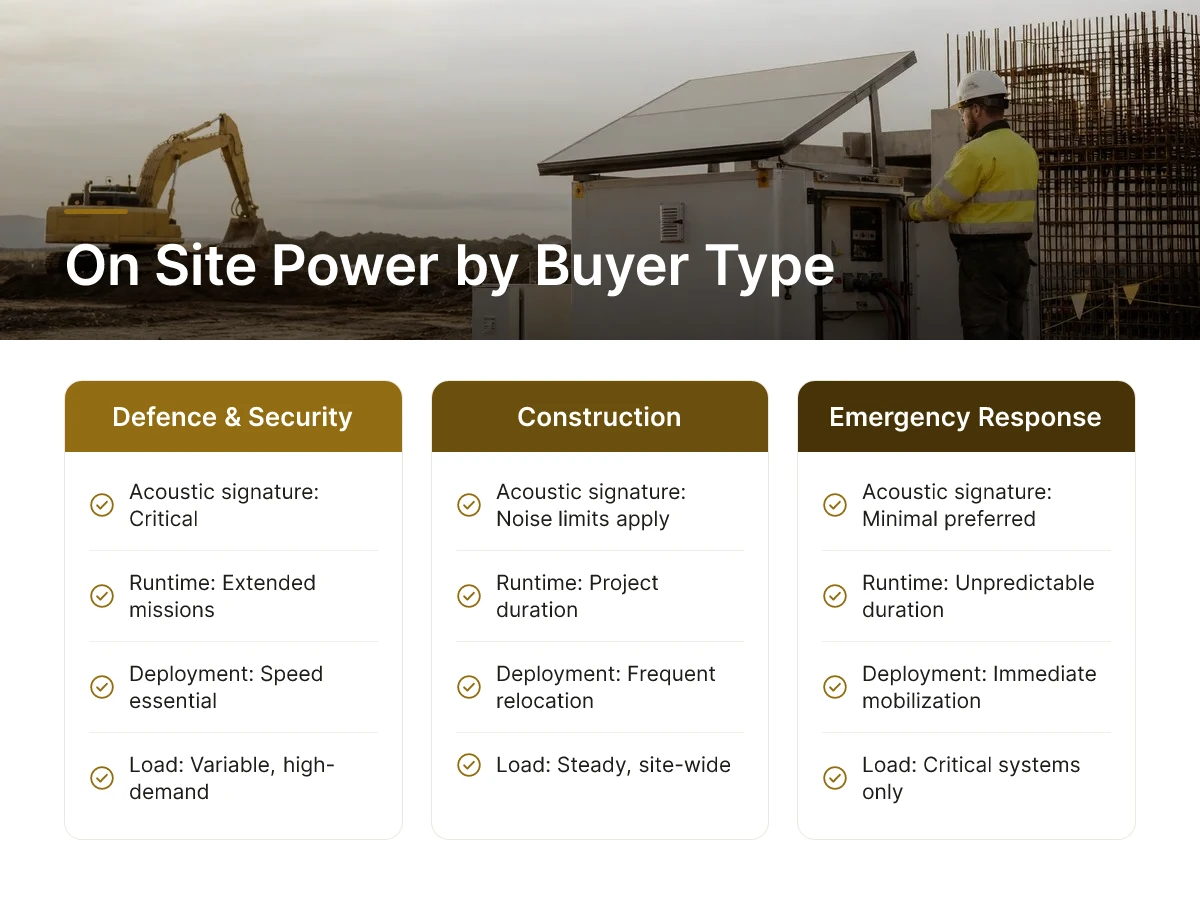
The right on site power configuration depends on mission duration, noise tolerance, and load size, a drone recharging station and a whole-site microgrid have almost nothing in common.
Four buyer types drive most demand for hybrid power at remote or off-grid locations: defence units, equipment rental fleets, construction contractors, and emergency response teams. Each weighs acoustic signature, runtime, and deployment speed differently, which is why Hybridps configures systems across power tiers rather than selling one generic unit.
What Specifications Matter Most for Defence and Security Operations?
Forward operating bases need fuel-logistics reduction and low acoustic and thermal signature above almost every other spec.
Every diesel resupply convoy is a target. Cutting the frequency of those runs is a force-protection outcome, not just a cost saving. A hybrid system that runs silent on battery for stretches and recharges from solar, a generator, or vehicle alternators reduces both the number of convoy trips and the heat/noise profile that gives away a position, relevant for tactical power and for recharging reconnaissance and strike drones between sorties. For FOB-scale loads, the TERRA hybrid microgrid (167 kVA continuous / 250 kVA peak, 162 kWh) is built for this tier, supporting multiple structures and vehicle charging off one deployable platform. Review configurations on the Mobile Hybrid Microgrid page.
How Do Rental Fleets and Contractors Choose Between Portable Packs and Stationary Systems?
Rental fleets need durable, low-maintenance units that scale with job length; contractors need quiet, multi-input power that won't trigger noise complaints.
Rental operators can't afford frequent service calls on units that rotate between renters with varying skill levels. LiFePO4 battery packs hold up to that cycling better than lead-acid alternatives and need far less upkeep than a diesel genset with oil changes and filters. A buy-or-rent model lets a fleet manager match capacity to a specific contract instead of carrying idle inventory, see Buy or Rent and the Portable Power Packs lineup.
Construction crews have a narrower problem: running tools and lighting overnight without violating municipal noise bylaws or waking the neighbourhood next to the site. A silent battery system with solar, grid, or generator charging inputs covers that gap. The Batt Pack Pro 5kW and Batt Pack Jupiter 7kW handle single-crew tool loads and overnight security lighting without a running engine on site.
Emergency response sits apart again, speed of deployment matters more than brand loyalty to any one tier. When grid power fails and diesel resupply is uncertain, a unit that deploys in minutes and runs continuously off whatever charging input is available (solar, grid remnants, a portable generator) keeps critical loads up. Portable packs in the 3–7 kW range suit single-tool or single-crew response tasks; when the load is a whole command post or shelter, the Spark Cube 12/24kW or TERRA scale past what any briefcase-class unit can deliver.
What Permitting, Emissions, and Grid Interconnection Rules Apply to On Site Power?
Rules for on site power vary by jurisdiction and site type, but they generally fall into three categories: noise limits, emissions or run-hour restrictions, and grid interconnection safety requirements.
No single standard governs every deployment. A municipal construction site, a private mining operation, and a military base each answer to different authorities, and the requirements layered on top of each other can shift from one county or province to the next.
How Do Noise Ordinances and Emissions Rules Shape System Design?
Local noise ordinances often restrict permissible decibel levels during set hours, and many urban construction permits carry night-work restrictions that make diesel-only generator setups a liability after sunset. A generator running at full load outside permitted hours can trigger fines or stop-work orders, which is why rental fleets and contractors increasingly spec hybrid systems with a lower acoustic signature for overnight and residential-adjacent work. Emissions regulations add a second constraint. Many jurisdictions cap generator idling time or require run-hour logging to limit exposure to diesel exhaust near workers and the public. Hybrid charging, drawing from a battery bank topped up by solar, alternator, grid, or generator input, cuts the number of hours a diesel engine needs to run, which reduces how often a site brushes up against those limits. Hybrid Power Solutions builds its Batt Pack and Spark Cube lines around this logic: LiFePO4 storage absorbs the load so the generator can idle less and cycle only when needed, rather than run continuously to meet peak demand. The EPA's on-site renewable energy generation resources provide useful background on how emissions considerations factor into site-level energy decisions.
What Safety Certifications Matter for Grid-Connected Hybrid Systems?
When a hybrid system supplements grid power rather than fully replacing it, interconnection safety becomes the controlling issue, not noise or emissions. Utilities and electrical codes typically require certified transfer switches and proven isolation from utility lines to prevent backfeed, a hazard for line workers and a common cause of failed inspections [2]. This matters most for sites that blend grid, generator, and battery inputs, such as a utility truck outfit or a construction site with partial grid access. Any equipment tied into utility infrastructure should carry documentation confirming isolation and switching behaviour meets the local utility's interconnection standard before energization.
Operators should treat permitting as a local question first. A forward operating base, a municipal job site, and a private industrial facility can carry entirely different noise thresholds, emissions reporting obligations, and interconnection approval processes, confirm current rules with the relevant authority rather than assuming a single national standard applies.
Frequently Asked Questions
Can on site power systems fully replace a diesel generator?
In many deployments, yes, a hybrid battery system with solar, alternator, or generator charging inputs can fully displace a diesel unit on site. For loads that exceed battery capacity or demand continuous high draw, pairing a smaller generator with battery storage for peak shaving still cuts fuel use significantly. The right configuration depends on load profile, site duration, and available charging sources.
How long can a hybrid battery system run before it needs recharging?
Runtime depends on load size and battery capacity, not a fixed number. A Batt Pack Energy 3kW or Pro 5kW unit suits smaller tool and lighting loads with longer stretches between charges, while a Spark Cube 12/24kW or TERRA microgrid (167 kVA continuous, 162 kWh) supports whole-site power with solar, alternator, grid, or generator charging for continuous operation without full recharge downtime.
Is on site hybrid power reliable in extreme cold?
Yes, Hybridps systems are engineered and tested for operation down to -30°C, avoiding the cold-start failures and fuel gelling that plague diesel units in winter. This matters most for northern construction sites, mining operations, and defence deployments in Arctic or sub-Arctic conditions where generator downtime isn't an option.
Do rental fleets need different on site power equipment than construction contractors?
Rental fleets prioritize durability and low maintenance across repeated deployments, while contractors often need silent overnight power on active job sites. Both groups can draw from the same product line, Batt Pack Pro and Jupiter units for job sites, Spark Cube for larger rental-grade loads, but rental operators should ask about buy-or-rent terms built for high utilization.
What makes LiFePO4 batteries different from standard lithium-ion for on site power?
LiFePO4 (lithium iron phosphate) offers longer cycle life and greater thermal stability than standard lithium-ion chemistries, reducing fire risk under heavy field use. For remote and defence sites where replacement logistics are costly, that extended service life and safety margin matter more than marginal energy density gains.
Conclusion
On site power is shifting from a single diesel generator to a mix of battery storage, solar, and smaller generators working together. Three things matter most when making that shift: matching battery capacity to your actual load profile, confirming cold-weather performance if you operate in northern or Arctic conditions, and choosing hybrid multi-input systems over battery-only packs if your deployment runs longer than a few days.
Start by auditing one active site's fuel logs and generator runtime over the past 90 days, that data will tell you whether a Batt Pack, Spark Cube, or TERRA-scale microgrid fits your load before you commit to hardware.
Sources & References
- Onsite Power Generation | Control Your Energy Future
- On-Site Power Generation | Electric Power Generation | Services | Burns & McDonnell
Recommended Articles
Explore more from our content library: